
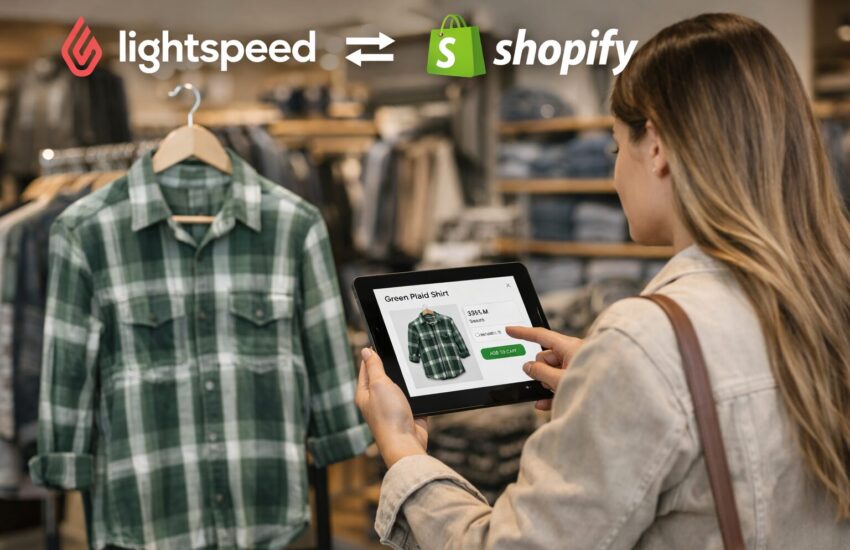
Retailers today operate in a fast-moving environment where customers expect seamless shopping experiences across online and physical stores. Many retailers use Lightspeed for in-store operations and Shopify for online sales. However, without proper Lightspeed Shopify Integration, these systems often function like two separate businesses. This disconnect creates operational stress, inventory errors, and missed growth opportunities.
Before integration, many retailers rely on manual processes. Staff update inventory separately in Lightspeed and Shopify. Prices are changed twice – once in POS and once online. Promotions must be configured in both systems. Online orders may need to be manually entered into the POS. These processes consume valuable time and increase the risk of mistakes. Overselling becomes common when stock is not updated in real time. Customers see products online that are not actually available in-store. Refunds increase, customer satisfaction drops, and staff morale suffers.
In today’s competitive retail market, this situation is no longer sustainable. Customers expect accurate inventory visibility, flexible fulfillment options, and smooth service. Omnichannel retail is not a luxury – it is the standard. Features like Buy Online, Pick Up In Store (BOPIS), real-time stock availability, and unified returns are becoming basic expectations. Without structured Lightspeed and Shopify Integration, delivering these experiences consistently becomes extremely difficult.
Lightspeed POS is widely used across different retail verticals, and each vertical has unique integration needs. Fashion and apparel retailers manage size and color variants, seasonal collections, and frequent promotions. Without accurate integration logic, variant mismatches and stock discrepancies quickly occur. Electronics retailers deal with high-value items, serial numbers, and bundled products, where even a small inventory error can create financial risk. Health and beauty retailers manage product kits, repeat purchase behavior, and sometimes regulated inventory, requiring precise synchronization. Specialty and lifestyle stores may operate with customized products or mixed fulfillment models, making workflow mapping essential.
This diversity means that Lightspeed Shopify Integration is not simply about connecting two systems. It requires understanding how the retailer operates. For example, should inventory sync in real time or in scheduled intervals? Should online orders automatically reduce store inventory? How should returns be processed across channels? How will BOPIS orders be reserved and communicated to store staff? These are operational questions, not just technical ones.
Before proper integration, retailers often experience fragmented reporting. Sales data from online and in-store channels may not align clearly. Managers struggle to get a unified view of performance. Decision-making becomes reactive rather than strategic. Growth feels operationally stressful instead of exciting. Adding a second store or expanding ecommerce capacity only amplifies existing weaknesses.
After well-planned Lightspeed Shopify Integration, the difference is noticeable. Inventory updates automatically across channels. Pricing remains consistent. Orders flow smoothly from Shopify into Lightspeed. BOPIS becomes streamlined because inventory is reserved correctly and store teams are notified efficiently. Reporting becomes centralized, allowing leadership to make informed decisions. Retailers shift from manual firefighting to scalable growth management.
However, the biggest challenge is not the technology itself. The challenge lies in choosing the right integration approach and vendor. There are multiple integration providers in the market, each with different features, pricing models, and technical limitations. Retailers often struggle to evaluate these options objectively. Without deep integration experience, it is difficult to identify hidden risks or long-term scalability issues.
This is where Retail Matchmaker becomes essential. Retail Matchmaker does not sell software. Instead, it acts as a neutral advisor that helps retailers make confident, informed decisions. The process begins with understanding the retailer’s business model, workflows, pain points, and growth plans. Rather than jumping into vendor demos, Retail Matchmaker focuses on clarifying operational requirements.
Retail Matchmaker translates business needs into structured workflows and integration rules. They define how inventory should sync, how product variants should map, how orders should flow, and how returns should be processed. They help retailers think through omnichannel scenarios, including BOPIS, multi-store operations, and future expansion. By documenting these requirements clearly, they eliminate ambiguity before vendor selection begins.
Vendor evaluation then becomes simpler and more strategic. Instead of comparing features blindly, retailers can evaluate integration partners based on clearly defined needs. Retail Matchmaker shortlists suitable vendors, explains trade-offs in simple language, and helps retailers avoid costly implementation mistakes. This approach saves time, reduces risk, and ensures that the integration supports long-term scalability.
In an environment where retail technology decisions are expensive and difficult to reverse, expert guidance makes a measurable difference. Lightspeed and Shopify Integration has the power to unify operations, enhance customer experience, and enable true omnichannel retail. But success depends on planning, workflow clarity, and selecting the right integration partner.
Retailers who approach integration strategically move from manual chaos to operational control. With Retail Matchmaker’s expertise, they gain clarity, reduce stress, and build a foundation for sustainable growth. In today’s retail landscape, making the right integration decision the first time is not just smart – it is essential for staying competitive.

