

Industry Research Report | August 2026
The Future of Omnichannel Retail Operations 2026
Published: August 2026
Report Type: Industry Research Report
Reading Time: ~22 minutes
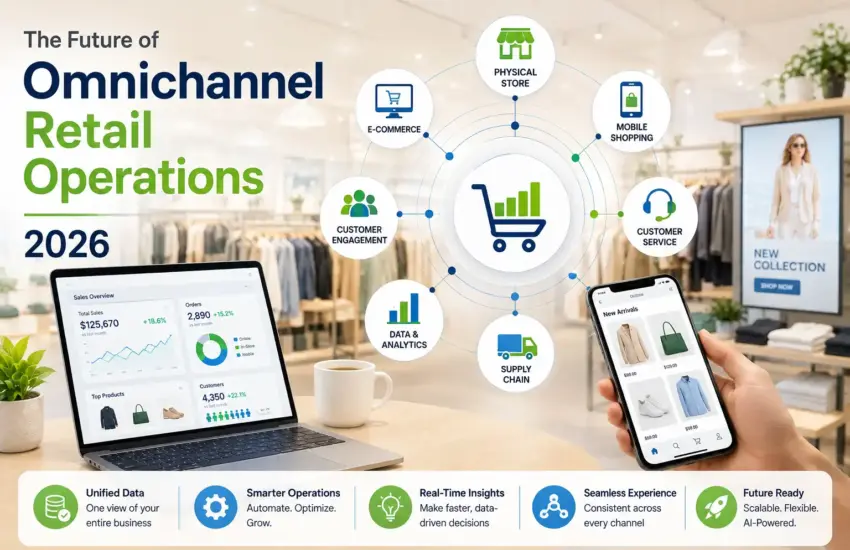
Executive Summary
Omnichannel retail has evolved from simply selling through multiple channels to creating a connected retail environment in which stores, eCommerce platforms, marketplaces, mobile commerce, inventory systems, and customer data work together as a unified operation. In 2026, retailers are increasingly expected to provide customers with consistent product availability, pricing, fulfilment, service, and purchasing experiences regardless of where or how a transaction takes place.
The complexity of managing these connected operations continues to increase. Retailers must synchronize inventory across locations and channels, process orders through multiple fulfilment options, maintain consistent product and customer information, and support services such as Buy Online, Pick Up In Store (BOPIS), Buy Online, Return In Store (BORIS), ship-from-store, and curbside pickup.
Technology is becoming central to addressing this complexity. POS systems, eCommerce platforms, Order Management Systems, inventory management solutions, CRM platforms, Warehouse Management Systems, payment systems, marketplaces, and analytics platforms increasingly need to operate as parts of a connected ecosystem rather than as isolated applications.
Artificial intelligence is further accelerating this transformation. Predictive analytics, intelligent inventory optimization, automated order routing, conversational AI, computer vision, and emerging AI agents are enabling retailers to move from reactive operations toward more predictive and automated decision-making.
This report examines the current state of omnichannel retail operations, the technologies driving transformation, the operational and business benefits of connected commerce, the challenges retailers must address, and the trends expected to shape omnichannel retail between 2026 and 2030.
The objective is to provide retailers and retail technology decision-makers with a practical framework for understanding how connected retail operations can improve customer experience, operational efficiency, inventory visibility, fulfilment, and long-term business scalability.
1. Introduction
Retail has moved beyond the traditional distinction between physical stores and online channels. Customers increasingly expect to interact with a retailer as a single business, regardless of whether they discover a product online, purchase through an eCommerce website, visit a physical store, use a mobile device, or collect an order from a nearby location.
This shift has made omnichannel retail operations significantly more complex. A retailer must coordinate product information, inventory, pricing, orders, customer data, payments, fulfilment, and returns across multiple systems and locations. A disconnected technology environment can create inaccurate inventory information, delayed order processing, inconsistent customer experiences, and unnecessary manual work.
The transition from multichannel retail to omnichannel operations therefore requires more than adding new sales channels. It requires the underlying retail systems to communicate reliably and operate as part of a connected ecosystem.
Modern integration technologies are helping retailers achieve this connectivity. POS systems can exchange information with eCommerce platforms, inventory systems can provide real-time availability across channels, and order management systems can determine how and where an order should be fulfilled. Customer and transaction information can also flow across systems to create a more consistent view of the customer.
At the same time, artificial intelligence and automation are introducing new capabilities into omnichannel operations. Retailers can increasingly use predictive analytics to anticipate demand, intelligent systems to optimize fulfilment, and automated workflows to identify and respond to operational exceptions.
The result is a gradual transition from multichannel retailing, where channels operate alongside one another, toward unified commerce, where technology and operations are designed around a connected customer journey.
This report examines how omnichannel retail operations are evolving in 2026, the technologies supporting this transformation, the challenges retailers face when connecting their systems, and the emerging developments expected to influence retail operations through 2030.
The focus is not simply on adding more channels. It is on creating a retail operation in which customers, stores, products, inventory, orders, and technology systems remain connected throughout the entire commerce journey.
2. Research Objectives
The primary objective of this report is to examine how omnichannel retail operations are evolving and how connected technology ecosystems can help retailers deliver more consistent, efficient, and scalable commerce experiences.
The report specifically aims to:
- Examine the evolution of omnichannel retail from separate sales channels toward unified commerce operations.
- Identify the key operational requirements for managing stores, eCommerce, marketplaces, mobile commerce, fulfilment, and returns as a connected ecosystem.
- Assess the role of retail technology integrations in synchronizing inventory, orders, products, customer data, and other operational information.
- Evaluate emerging technologies such as artificial intelligence, predictive analytics, RFID, IoT, computer vision, and automation that are influencing omnichannel operations.
- Identify the major business benefits associated with connected retail operations, including improved inventory visibility, fulfilment efficiency, customer experience, and scalability.
- Examine implementation challenges including legacy systems, data silos, integration complexity, cybersecurity, organizational change, and technology costs.
- Explore future developments expected to influence omnichannel retail operations between 2026 and 2030.
- Provide practical strategic recommendations that can help retailers evaluate and strengthen their omnichannel technology infrastructure.
The overall objective is to provide retailers and retail technology decision-makers with a clear understanding of the technology, operational, and strategic considerations involved in building a connected omnichannel retail environment.
3. Research Methodology
This report uses a structured qualitative research approach to examine the current state and future direction of omnichannel retail operations. The analysis combines established retail technology concepts, operational practices, industry developments, and emerging technology trends relevant to connected commerce.
The methodology focuses on understanding how different retail systems and operational processes interact across physical and digital channels rather than evaluating any single technology vendor.
The research considers the following areas:
- Retail technology ecosystem: Analysis of the systems commonly involved in omnichannel operations, including POS, eCommerce, inventory management, order management, CRM, WMS, payment systems, marketplaces, and analytics platforms.
- Operational workflows: Examination of processes such as inventory synchronization, order fulfilment, BOPIS, BORIS, ship-from-store, returns, and cross-channel customer service.
- Technology trends: Assessment of emerging technologies influencing omnichannel operations, including artificial intelligence, predictive analytics, RFID, IoT, computer vision, automation, and AI agents.
- Business outcomes: Evaluation of how connected operations can influence inventory accuracy, fulfilment efficiency, customer experience, operational costs, scalability, and decision-making.
- Implementation considerations: Review of common challenges associated with legacy systems, data quality, integration complexity, cybersecurity, organizational readiness, and technology adoption.
- Future developments: Analysis of emerging trends expected to influence omnichannel retail operations between 2026 and 2030.
The report is intended as an independent industry analysis rather than a vendor-specific assessment. Its recommendations are designed to provide practical guidance for retailers evaluating their current technology environment and planning future omnichannel initiatives.
4. Understanding Omnichannel Retail Operations
Omnichannel retail operations represent the integration of a retailer’s physical and digital channels into a connected operating environment. The objective is not simply to offer products through multiple channels, but to ensure that customers, inventory, orders, product information, and business processes remain coordinated throughout the commerce journey.
A customer may discover a product through a retailer’s website, check its availability at a nearby store, purchase it online, collect it from the store, and later return it at a different location. From the customer’s perspective, these are different touchpoints of the same relationship. For the retailer, however, each interaction can involve multiple technology systems and operational processes.
Effective omnichannel operations connect these systems so that information can move consistently between them.
4.1 From Multichannel to Omnichannel Retail
Multichannel retail refers to selling through multiple independent channels. A retailer may operate physical stores, an eCommerce website, marketplaces, and mobile commerce simultaneously, but each channel may have its own inventory, customer data, order processes, and operational workflows.
This approach can increase market reach, but it can also create operational silos.
Omnichannel retail takes a different approach. Instead of treating each channel independently, it seeks to connect them through shared data and coordinated processes.
| Multichannel Retail | Omnichannel Retail |
|---|---|
| Channels operate independently | Channels operate as a connected ecosystem |
| Separate inventory visibility | Shared inventory visibility |
| Channel-specific customer data | Connected customer information |
| Independent order workflows | Coordinated order fulfilment |
| Channel-specific experiences | Consistent customer journey |
| Limited cross-channel services | Cross-channel services such as BOPIS and BORIS |
The transition to omnichannel operations therefore requires both technological integration and operational alignment.
4.2 Connected Customer Journeys
An effective omnichannel strategy begins with the customer journey rather than the technology platform.
Customers increasingly move between channels before, during, and after a purchase. They may research products online, visit a store to evaluate them, complete the purchase through an eCommerce website, and contact customer service through another channel.
Retailers therefore need to maintain continuity across these interactions.
A connected customer journey requires:
- Consistent product information
- Accurate inventory availability
- Consistent pricing and promotions
- Accessible order information
- Connected customer profiles
- Flexible fulfilment options
- Cross-channel returns and service
When these capabilities work together, customers experience the retailer as a single connected business rather than a collection of separate channels.
4.3 Unified Inventory Visibility
Inventory visibility is one of the foundations of successful omnichannel operations.
A retailer may have inventory distributed across stores, warehouses, distribution centers, and third-party fulfilment locations. Without a connected view of this inventory, online availability may not accurately reflect physical stock.
Real-time or near-real-time inventory synchronization can help retailers:
- Display more accurate product availability.
- Reduce overselling.
- Identify stock across locations.
- Support ship-from-store fulfilment.
- Enable BOPIS.
- Improve replenishment decisions.
Inventory therefore becomes a shared operational resource rather than an asset associated with a single sales channel.
4.4 Unified Order Management
Omnichannel operations also require retailers to manage orders independently of the channel through which they originated.
An order may be placed online but fulfilled from a store, warehouse, or another location. Similarly, a customer may return an online purchase to a physical store.
An effective order management environment should provide visibility across:
- Order creation
- Payment status
- Inventory allocation
- Fulfilment
- Shipping
- Store pickup
- Returns
- Exchanges
Connecting these processes enables retailers to select the most appropriate fulfilment method while providing customers with greater flexibility.
4.5 Unified Commerce Ecosystem
The long-term evolution of omnichannel retail is increasingly associated with unified commerce.
While omnichannel focuses on connecting customer-facing channels, unified commerce extends this concept to the underlying technology infrastructure. POS, eCommerce, inventory, order management, CRM, payments, fulfilment, and other systems operate as interconnected components of a broader retail ecosystem.
The distinction can be summarized as follows:
Omnichannel connects the customer experience. Unified commerce connects the underlying retail operation that delivers that experience.
This distinction is increasingly important as retailers adopt more channels and increasingly sophisticated fulfilment models.
4.6 The Role of Integration
Technology integration provides the foundation for connecting these operational components.
Retailers may need to synchronize information between:
- POS systems
- eCommerce platforms
- Inventory management systems
- Order Management Systems
- CRM platforms
- Warehouse Management Systems
- Payment systems
- Marketplaces
- Shipping and fulfilment platforms
- Analytics and reporting systems
The quality of these integrations directly affects the reliability of the overall omnichannel operation.
Poorly connected systems can create duplicate data, synchronization failures, inaccurate inventory, delayed orders, and inconsistent customer information. Well-designed integrations can reduce these problems while creating a more scalable foundation for future automation and AI adoption.
Key Takeaway
Omnichannel retail operations are fundamentally about connectivity and consistency.
The objective is not simply to operate more sales channels. It is to ensure that those channels share the information and operational capabilities necessary to provide customers with a continuous experience.
As retailers move toward unified commerce, the ability to connect systems, synchronize data, and coordinate operational processes will become increasingly important to long-term retail performance.
5. Key Drivers of Omnichannel Transformation
The shift toward omnichannel retail is being driven by changes in customer behavior, increasing operational complexity, and the need for retailers to compete across physical and digital channels simultaneously. Retailers are no longer evaluating channels independently. They are increasingly looking at how stores, websites, marketplaces, inventory, fulfilment, and customer data can work together as a connected operation.
Several factors are accelerating this transformation.
5.1 Changing Customer Expectations
Customers increasingly expect retailers to provide consistent experiences across every interaction. They want accurate product availability, transparent pricing, flexible fulfilment, convenient returns, and timely communication regardless of the channel they use.
Customers may also move between channels during a single purchase journey. They can research a product online, visit a store, purchase through a mobile device, and later return the product at another location.
Retailers therefore need connected systems capable of maintaining continuity throughout these interactions.
5.2 Mobile-First Shopping
Mobile devices have become an important component of the modern retail journey. Customers use smartphones to discover products, compare prices, check store availability, read reviews, make purchases, and track orders.
Mobile commerce also creates opportunities for retailers to connect digital interactions with physical stores through capabilities such as:
- Mobile ordering
- Digital loyalty programs
- Store inventory lookup
- Mobile payments
- Digital receipts
- Location-based offers
- In-store product discovery
These experiences depend on accurate, timely information flowing between mobile applications, eCommerce platforms, POS systems, inventory systems, and customer databases.
5.3 Buy Online, Pick Up In Store (BOPIS)
BOPIS allows customers to purchase products online and collect them from a physical store. It has become an important example of how digital and physical retail channels can work together.
Successful BOPIS requires retailers to coordinate:
- Online order processing
- Store-level inventory
- Order allocation
- Store preparation
- Customer notifications
- Pickup confirmation
Inventory accuracy is particularly important. If an online system shows a product as available when it is not physically available at the selected location, the customer experience can quickly deteriorate.
5.4 Buy Online, Return In Store (BORIS)
Returns are another area where omnichannel integration can create significant customer convenience.
BORIS enables customers to return online purchases through physical stores. This requires the retailer’s store systems and eCommerce operations to share relevant order and customer information.
Connected return processes can help retailers:
- Verify online purchases at physical locations
- Process refunds or exchanges
- Update inventory
- Maintain accurate customer records
- Reduce return-related friction
A consistent returns experience can also strengthen customer confidence in purchasing through digital channels.
5.5 Unified Customer Profiles
Customers increasingly interact with retailers through multiple channels. Without connected customer data, each interaction may appear to be associated with a different customer.
Unified customer profiles allow retailers to connect information such as:
- Purchase history
- Loyalty activity
- Customer preferences
- Online behavior
- Store interactions
- Returns and exchanges
- Customer service interactions
This creates a more complete understanding of the customer and enables more consistent service across channels.
5.6 Real-Time Inventory Visibility
As omnichannel fulfilment models become more sophisticated, inventory visibility becomes increasingly important.
Retailers need to know not only how much inventory they have, but where that inventory is located and whether it is actually available for fulfilment.
Connected inventory systems can support:
- Store-level availability
- Warehouse visibility
- Online stock availability
- Ship-from-store
- BOPIS
- Inventory transfers
- Replenishment planning
Improved inventory visibility reduces the likelihood of overselling while allowing retailers to make better use of inventory distributed across their network.
5.7 Faster Fulfilment Expectations
Customers increasingly expect faster and more flexible fulfilment options. Retailers are responding with services such as same-day delivery, next-day delivery, store pickup, curbside collection, and ship-from-store.
These services require coordination between inventory, order management, stores, warehouses, shipping providers, and customer communication systems.
A connected technology environment enables retailers to evaluate available inventory and fulfilment capacity before determining how an order should be processed.
5.8 Expansion of Marketplaces and Digital Channels
Many retailers now sell through third-party marketplaces in addition to their own eCommerce websites and physical stores.
Each additional channel introduces requirements for synchronizing:
- Product information
- Pricing
- Inventory
- Orders
- Customer information
- Fulfilment status
Without appropriate integration, managing multiple channels can create significant manual workload and increase the risk of inconsistent information.
5.9 Competitive Pressure
Retailers are increasingly competing not only on products and prices but also on convenience, fulfilment speed, availability, personalization, and service.
Businesses that provide connected experiences can differentiate themselves through:
- Flexible purchasing options
- Accurate inventory information
- Convenient fulfilment
- Cross-channel returns
- Personalized interactions
- Consistent customer service
As customer expectations continue to rise, omnichannel capability is becoming an important component of retail competitiveness.
Key Takeaway
The transition toward omnichannel retail is being driven by a combination of customer expectations, technological change, operational complexity, and competitive pressure.
Retailers that successfully connect their channels can use their existing stores, inventory, technology infrastructure, and customer relationships more effectively. The ability to coordinate these assets will become increasingly important as commerce continues to move toward unified and intelligent retail operations.
6. Core Components of Modern Omnichannel Operations
Modern omnichannel retail depends on multiple technology systems working together as a coordinated ecosystem. Each system performs a specific operational function, but the overall customer experience depends on how effectively these systems exchange information.
A retailer may have an excellent eCommerce platform, POS system, or inventory solution individually, but disconnected systems can still create operational problems. Omnichannel success therefore depends on reliable data synchronization, consistent business rules, and well-designed integration architecture.
6.1 Point of Sale (POS) Systems
The POS system remains a central component of physical retail operations. It processes transactions while also generating information about sales, inventory, customers, payments, returns, and exchanges. Retailers evaluating connected POS environments can explore our Lightspeed POS Integration Services.
In an omnichannel environment, POS systems increasingly need to exchange information with:
- eCommerce platforms
- Inventory systems
- Customer databases
- Order management systems
- Loyalty platforms
- Accounting systems
Connected POS operations allow store transactions to influence online inventory availability and enable retailers to support services such as BOPIS, BORIS, and ship-from-store.
6.2 eCommerce Platforms
The eCommerce platform provides the primary digital storefront for many retailers. It manages product presentation, online transactions, customer accounts, promotions, and digital orders. Retailers planning or upgrading their online storefront can explore our eCommerce Website Development services.
For omnichannel operations, the eCommerce platform must remain synchronized with other retail systems.
Important information includes:
- Product catalogues
- Prices
- Inventory availability
- Customer information
- Orders
- Promotions
- Fulfilment status
Reliable connectivity prevents customers from receiving outdated information and enables online orders to be processed using inventory across the broader retail network.
6.3 Inventory Management Systems
Inventory management is one of the most critical components of omnichannel operations.
Retailers need visibility into inventory across stores, warehouses, distribution centers, and other fulfilment locations.
An effective inventory environment should support:
- Real-time or near-real-time inventory updates
- Location-level inventory visibility
- Stock transfers
- Replenishment
- Inventory adjustments
- Reserved inventory
- Available-to-promise quantities
Accurate inventory information provides the foundation for reliable online availability and flexible fulfilment.
6.4 Order Management Systems (OMS)
An Order Management System coordinates orders across multiple channels and fulfilment locations.
An OMS can determine:
- Where an order should be fulfilled
- Which inventory should be allocated
- How an order should be shipped
- Whether store pickup is available
- How split orders should be handled
- How returns should be processed
As retailers adopt increasingly flexible fulfilment models, the OMS becomes an important coordination layer between customer-facing channels and physical inventory.
6.5 Customer Relationship Management (CRM)
CRM systems provide a centralized view of customer relationships and interactions.
In an omnichannel environment, customer information may originate from:
- Store purchases
- eCommerce transactions
- Loyalty programs
- Marketing interactions
- Customer service
- Returns and exchanges
Connecting these data sources allows retailers to develop more complete customer profiles and deliver more consistent experiences across channels.
6.6 Warehouse Management Systems (WMS)
Warehouse Management Systems coordinate activities within warehouses and distribution centers.
Integration with other retail systems allows warehouse operations to respond to actual customer demand and order requirements.
Important capabilities include:
- Inventory tracking
- Picking and packing
- Order prioritization
- Shipment preparation
- Warehouse allocation
- Returns processing
WMS integration becomes particularly important when retailers use warehouses to fulfil both online and store replenishment orders.
6.7 Payment Systems
Payment platforms support transactions across physical and digital channels.
Omnichannel payment integration helps retailers maintain consistent transaction processing while supporting different purchasing and fulfilment models.
Examples include:
- In-store payments
- Online payments
- Mobile payments
- Contactless payments
- Refunds
- Exchanges
- Store-credit transactions
Payment information must be processed securely while remaining synchronized with the appropriate order and customer records.
6.8 Marketplace Integration
Third-party marketplaces provide retailers with additional opportunities to reach customers, but they also increase operational complexity.
Marketplace integrations can synchronize:
- Product information
- Pricing
- Inventory
- Orders
- Fulfilment status
Without automated connectivity, managing multiple marketplaces can require substantial manual effort and increase the risk of inconsistent inventory and product information.
6.9 Analytics and Business Intelligence
Omnichannel operations generate large volumes of data across sales, inventory, customers, fulfilment, and marketing.
Analytics platforms bring this information together to help retailers understand:
- Sales performance
- Channel performance
- Inventory movement
- Customer behavior
- Fulfilment efficiency
- Product performance
- Operational trends
Advanced analytics can also provide predictive insights that support purchasing, merchandising, inventory planning, and strategic decision-making.
6.10 Integration and Middleware Platforms
As the number of retail applications increases, retailers need an effective mechanism for connecting these systems.
Integration and middleware platforms can facilitate data exchange between POS, eCommerce, inventory, OMS, CRM, WMS, marketplaces, accounting platforms, and other applications.
A well-designed integration layer can provide:
- Data synchronization
- API connectivity
- Workflow automation
- Error handling
- System monitoring
- Data transformation
- Scalability
This layer is particularly important for retailers operating multiple locations and sales channels because it reduces the need to build and maintain numerous isolated point-to-point connections.
Building the Connected Retail Foundation
These components do not operate independently. Their value increases when they work together as a coordinated technology ecosystem.
For example, a customer placing an online order may trigger a sequence involving the eCommerce platform, inventory system, OMS, POS or store system, payment platform, warehouse or fulfilment operation, and customer communication system.
The effectiveness of this entire process depends on the accuracy and speed with which information moves between the connected systems.
Therefore, the foundation of modern omnichannel retail is not any single platform. It is the ability to connect the technology ecosystem and maintain consistent information across every operational touchpoint.
7. Emerging Technologies Shaping Omnichannel Retail
The next phase of omnichannel retail will be shaped by technologies that enable retailers to understand customer behaviour, predict demand, automate operational decisions, and connect physical and digital environments more intelligently.
While integration remains the foundation of omnichannel operations, emerging technologies are adding new layers of intelligence and automation. The following technologies are expected to have significant influence on retail operations during the coming years.
7.1 Artificial Intelligence
Artificial intelligence is becoming an important component of modern retail operations. AI can analyse large volumes of sales, inventory, customer, and operational data to identify patterns and support faster decision-making.
In omnichannel environments, AI can support:
- Demand forecasting
- Inventory optimization
- Product recommendations
- Customer segmentation
- Order prioritization
- Fraud detection
- Operational anomaly detection
AI is therefore moving retail operations from simple data synchronization toward more intelligent and predictive decision-making.
7.2 Predictive Analytics
Traditional retail analytics primarily explains what has already happened. Predictive analytics uses historical and real-time information to estimate what is likely to happen next.
Retailers can use predictive models to anticipate:
- Product demand
- Inventory shortages
- Customer purchasing behaviour
- Fulfilment requirements
- Promotional performance
- Potential operational disruptions
Predictive capabilities allow retailers to prepare for changing conditions rather than responding only after an event has occurred.
7.3 Intelligent Inventory Optimization
Inventory optimization is becoming increasingly sophisticated as retailers manage products across stores, warehouses, eCommerce channels, and marketplaces.
AI and predictive analytics can evaluate sales velocity, inventory levels, location, seasonality, and other relevant factors to recommend how inventory should be distributed.
Potential applications include:
- Automated replenishment recommendations
- Inventory allocation between locations
- Identification of slow-moving products
- Stockout prediction
- Excess inventory detection
- Improved fulfilment allocation
This allows retailers to treat inventory as a connected enterprise resource rather than as separate stock pools.
7.4 RFID and Smart Identification
Radio Frequency Identification (RFID) technology enables retailers to identify and track products using electronic tags.
When integrated with inventory and POS systems, RFID can improve visibility into product movement across stores, warehouses, and fulfilment operations.
Potential benefits include:
- Faster inventory counts
- Improved stock accuracy
- Reduced item-level discrepancies
- Better visibility of product movement
- Support for loss-prevention initiatives
RFID becomes particularly valuable when retailers need accurate information about individual products rather than only aggregate inventory quantities.
7.5 Internet of Things (IoT)
Internet of Things technologies connect physical devices and sensors to digital systems.
In retail environments, IoT devices can collect information about:
- Store conditions
- Equipment performance
- Customer traffic
- Inventory movement
- Refrigeration and temperature
- Energy consumption
Integrating this information with retail technology platforms can enable automated monitoring and faster responses to operational conditions.
7.6 Computer Vision
Computer vision allows software systems to interpret information from cameras and other visual sensors.
Retail applications may include:
- Shelf monitoring
- Product availability detection
- Store traffic analysis
- Checkout automation
- Loss prevention
- Visual product recognition
When connected to inventory and operational systems, computer vision can provide retailers with information that would otherwise require manual observation.
7.7 Conversational AI
Conversational AI is changing how customers and employees interact with retail systems.
AI-powered assistants can support:
- Product discovery
- Order tracking
- Frequently asked questions
- Returns information
- Customer service
- Employee assistance
When connected to eCommerce, order management, CRM, and inventory systems, conversational AI can provide responses based on current operational information rather than static knowledge alone.
7.8 Agentic AI
Agentic AI represents a further evolution of retail automation. Instead of simply responding to individual requests, AI agents can be designed to pursue defined objectives by analysing information, planning actions, and executing multi-step workflows within authorized boundaries.
Potential retail applications include:
- Monitoring inventory and initiating replenishment workflows
- Identifying order exceptions and recommending resolutions
- Monitoring integration performance
- Assisting with product information management
- Coordinating routine operational tasks
Human oversight remains important, particularly for decisions involving financial, customer, or operational risk.
7.9 Hyper-Personalization
Connected customer data enables retailers to move beyond broad customer segments toward increasingly personalized experiences.
AI can combine information such as purchase history, browsing behavior, preferences, and engagement patterns to support:
- Personalized product recommendations
- Individualized promotions
- Targeted communications
- Personalized loyalty experiences
- Context-aware offers
The effectiveness of these capabilities depends heavily on accurate customer data and appropriate privacy controls.
7.10 Hyperautomation
Hyperautomation combines multiple technologies – including workflow automation, AI, analytics, and integration platforms—to automate complex business processes.
In omnichannel retail, Hyperautomation can connect activities such as:
Customer order → Inventory verification → Order allocation → Fulfilment → Customer notification → Reporting
Automating these connected workflows can reduce manual intervention while improving consistency and processing speed.
7.11 Digital Twins
Digital twins create digital representations of physical environments or operational processes.
In retail, this concept can be applied to:
- Stores
- Warehouses
- Distribution networks
- Inventory flows
- Customer movement
- Fulfilment operations
Retailers could use digital models to simulate operational changes before implementing them in the physical environment. This may help organizations evaluate potential outcomes and identify operational bottlenecks.
The Convergence of Technologies
The most significant development is not any individual technology but the increasing convergence between them.
For example, a future retail operation could combine:
IoT sensors → Real-time data → AI analytics → Predictive decision → Automated workflow → POS/Inventory/OMS update
This creates a continuous operational feedback loop.
As integration platforms become more intelligent, these technologies will increasingly operate as interconnected components rather than isolated solutions. Retailers that establish a strong data and integration foundation will therefore be better positioned to adopt emerging technologies as they mature.
Key Takeaway
Emerging technologies are transforming omnichannel retail from a collection of connected sales channels into an increasingly intelligent operating environment.
AI, predictive analytics, RFID, IoT, computer vision, conversational AI, agentic AI, and automation each contribute different capabilities. Their greatest value, however, emerges when they are integrated into a unified retail ecosystem that can continuously exchange information and respond to changing business conditions.
8. Business Benefits of Omnichannel Retail Operations
A well-designed omnichannel retail environment can deliver benefits across customer experience, inventory management, fulfillment, operational efficiency, and business decision-making. The value comes from connecting previously separate systems and processes so that retailers can use their resources more effectively.
The benefits are not limited to digital sales. Physical stores, inventory, employees, technology platforms, and customer relationships can all become part of a coordinated retail operation.
8.1 Improved Inventory Accuracy
Connected inventory systems provide retailers with greater visibility into stock across stores, warehouses, and digital channels.
Improved inventory accuracy can help retailers:
- Reduce overselling
- Minimize stockouts
- Improve online availability information
- Support store-level fulfillment
- Improve replenishment decisions
- Reduce unnecessary inventory transfers
Accurate inventory information also improves customer confidence because product availability displayed online is more likely to reflect actual inventory.
8.2 Better Customer Experience
Customers benefit when they can move between physical and digital channels without losing access to relevant information.
An integrated omnichannel environment can provide:
- Consistent product information
- Accurate availability
- Flexible fulfillment options
- Cross-channel returns
- Consistent customer records
- Faster customer service
- Real-time order updates
These capabilities reduce friction throughout the customer journey and help retailers provide a more consistent experience.
8.3 Faster Order Fulfillment
Connected inventory and order management systems allow retailers to determine how orders can be fulfilled most efficiently.
For example, an online order may be fulfilled from:
- A nearby store
- A distribution center
- A warehouse
- A third-party fulfillment location
The ability to evaluate available inventory and fulfillment capacity across locations can reduce processing time and support faster delivery.
8.4 Reduced Operational Costs
Disconnected systems often require employees to manually enter information, reconcile records, investigate discrepancies, and coordinate processes across departments.
Omnichannel integration can reduce these activities through:
- Automated data synchronization
- Automated order processing
- Centralized information
- Workflow automation
- Automated customer notifications
- Reduced manual reconciliation
Reducing repetitive work allows employees to spend more time on customer service, merchandising, and other higher-value activities.
8.5 Increased Sales Opportunities
Omnichannel operations can make more of a retailer’s inventory available to customers.
For example, a product that is unavailable at one store may still be available at another location or warehouse. Connected systems can make this inventory visible to customers and employees.
Retailers can therefore increase sales opportunities through:
- Ship-from-store
- BOPIS
- Cross-location inventory
- Marketplace selling
- Online ordering
- Personalized recommendations
The retailer’s entire inventory network can become a potential source of sales rather than each location operating as an isolated inventory pool.
8.6 Improved Customer Retention
Consistent experiences across channels can strengthen customer relationships.
Customers are more likely to return when retailers provide:
- Reliable product availability
- Convenient fulfillment
- Flexible returns
- Personalized interactions
- Consistent service
- Accessible purchase history
Connected customer data also enables retailers to better understand purchasing patterns and develop more relevant loyalty and engagement strategies.
8.7 Better Employee Productivity
Employees often spend significant time searching for information or resolving issues caused by disconnected systems.
An integrated environment gives employees better access to:
- Customer information
- Product information
- Inventory availability
- Order status
- Purchase history
- Fulfillment information
This can reduce administrative work and help store and operations teams respond more quickly to customer needs.
8.8 More Effective Decision-Making
Omnichannel operations generate information across every customer and operational touchpoint.
When this information is connected, retailers can gain a broader view of:
- Sales performance
- Product demand
- Inventory movement
- Customer behavior
- Channel performance
- Fulfillment performance
- Store performance
Analytics and AI can then be applied to this connected information to identify trends and support more informed business decisions.
8.9 Greater Scalability
A well-designed technology architecture allows retailers to add stores, products, marketplaces, and sales channels without creating an equivalent increase in manual operational work.
Scalable omnichannel systems can support:
- New store locations
- Additional eCommerce channels
- New marketplaces
- Larger product catalogs
- Higher transaction volumes
- Additional fulfillment options
This is particularly important for growing retailers and multi-location businesses.
8.10 Stronger Operational Resilience
Connected operations can also improve a retailer’s ability to respond to unexpected changes.
When inventory, orders, fulfillment locations, and customer information are visible across the organization, retailers have more options when disruptions occur.
For example, if one location cannot fulfill an order, another location may be able to fulfill it. If a product becomes unavailable at one warehouse, inventory from another location may be allocated instead.
This flexibility can make the overall retail operation more resilient.
Key Takeaway
The primary value of omnichannel retail is not simply the ability to sell through more channels. It is the ability to coordinate those channels as one connected business.
When inventory, orders, customers, fulfillment, and technology systems operate together, retailers can improve efficiency while providing customers with greater convenience and consistency.
The next challenge is ensuring that this connected environment is reliable, secure, scalable, and practical to implement. That makes implementation challenges and considerations a critical part of any omnichannel transformation strategy.
9. Challenges and Implementation Considerations
Building a successful omnichannel retail operation requires more than connecting individual software platforms. Retailers must address technology, data, security, operational, and organizational challenges at the same time.
The complexity can increase significantly as retailers add more stores, sales channels, marketplaces, fulfillment options, and technology platforms. A carefully planned implementation approach is therefore essential.
9.1 Legacy Systems
Many retailers continue to rely on older POS, ERP, inventory, or accounting systems. These systems may not have modern APIs or may use proprietary data structures.
Connecting legacy platforms with newer eCommerce and cloud applications can require:
- Middleware
- Custom integrations
- Data transformation
- Additional monitoring
- Gradual system modernization
Retailers should evaluate existing technology limitations before developing an omnichannel roadmap.
9.2 Data Silos
Disconnected systems can create separate versions of product, inventory, customer, and order information.
Common examples include:
- Different inventory quantities across systems
- Duplicate customer records
- Inconsistent product information
- Different pricing between channels
- Incomplete order histories
These inconsistencies can directly affect customer experience and operational efficiency.
Creating common data structures and reliable synchronization processes is therefore a fundamental requirement for omnichannel operations.
9.3 Integration Complexity
As the number of connected systems increases, integration architecture becomes more complex.
A retailer may need to connect:
- POS
- eCommerce
- Inventory
- OMS
- CRM
- WMS
- Accounting
- Marketplaces
- Payment systems
- Shipping platforms
Point-to-point integrations can become difficult to maintain as the technology environment expands.
A scalable integration or middleware architecture can provide a centralized layer for data exchange, transformation, monitoring, and workflow management.
9.4 Cybersecurity and Data Privacy
Omnichannel operations require information to move between multiple systems and service providers. This increases the importance of security throughout the technology environment.
Retailers should consider:
- Secure API authentication
- Encryption
- Access controls
- Monitoring
- Data protection
- Vendor security practices
- Incident response procedures
Customer information and payment-related data require particular attention because security failures can create both financial and reputational consequences.
9.5 Change Management
Technology implementation changes how employees work.
Store employees, operations teams, customer service representatives, warehouse staff, and management may all interact differently with the new systems.
Successful implementation should therefore include:
- Employee training
- Clear process documentation
- Internal communication
- Defined responsibilities
- Ongoing support
Technology adoption is more effective when employees understand how the new environment improves their daily workflows.
9.6 Vendor Selection
Retailers often need multiple technology providers to support their omnichannel environment. Choosing platforms based solely on individual features can create integration problems later.
Retailers should evaluate vendors based on:
- API capabilities
- Integration support
- Scalability
- Security
- Reliability
- Documentation
- Customer support
- Long-term product roadmap
Compatibility between platforms should be considered before major technology investments are finalized.
9.7 Cost Considerations
Omnichannel transformation can require investment in software, integration development, infrastructure, data preparation, employee training, and ongoing maintenance.
Retailers should consider both initial and long-term costs.
Important factors include:
- Implementation expenses
- Subscription and licensing costs
- Integration maintenance
- Data migration
- Employee training
- Support requirements
- Future scalability
A phased approach can allow retailers to prioritize high-value capabilities while managing investment levels.
9.8 Scalability
An architecture that works for a small retailer may not work effectively after the business adds multiple stores, marketplaces, or higher transaction volumes.
Retailers should therefore consider future requirements when selecting technology and integration approaches.
Scalable architectures should be able to accommodate:
- Additional locations
- New sales channels
- Larger product catalogs
- Higher transaction volumes
- Additional fulfillment methods
- New technology capabilities
Designing for future growth can reduce the need for major technology restructuring later.
9.9 Governance and Operational Ownership
Connected retail systems require clear ownership.
Retailers should establish responsibility for:
- Data quality
- Integration monitoring
- System access
- Exception management
- Security
- Vendor relationships
- Performance measurement
Without clear ownership, integration failures or data problems may remain unresolved because responsibility is unclear.
9.10 Measuring Performance
Retailers should establish measurable objectives before beginning an omnichannel transformation.
Relevant metrics may include:
- Inventory accuracy
- Stockout frequency
- Order processing time
- Fulfillment time
- Return processing time
- Customer satisfaction
- Employee productivity
- Operational cost
- Online conversion
- Repeat purchase rate
Regular measurement allows retailers to determine whether their technology investments are delivering meaningful operational improvements.
Implementation Best Practices
Retailers planning an omnichannel transformation should consider the following approach:
- Define business objectives before selecting technology.
- Document existing systems and operational workflows.
- Identify data silos and synchronization problems.
- Prioritize high-impact integration opportunities.
- Establish a scalable integration architecture.
- Improve data quality before introducing advanced automation.
- Implement security and governance from the beginning.
- Train employees throughout the implementation.
- Measure operational results continuously.
- Expand the ecosystem gradually as capabilities mature.
Key Takeaway
Omnichannel transformation is both a technology initiative and an operational transformation.
Retailers that focus only on connecting systems may still encounter problems if their data, workflows, security practices, and organizational processes remain disconnected.
The strongest implementations combine reliable integration architecture, accurate data, secure technology, clearly defined processes, employee readiness, and continuous performance measurement.
This foundation will also make it easier for retailers to adopt emerging AI and automation capabilities as those technologies become more mature.
10. Future Outlook: Omnichannel Retail Operations 2026–2030
The next phase of omnichannel retail will move beyond simply connecting sales channels. Retailers are increasingly working toward unified commerce environments in which technology systems, inventory, customer data, fulfillment operations, and decision-making processes operate as a coordinated ecosystem.
Between 2026 and 2030, several developments are expected to influence how retailers design and manage these operations.
10.1 Unified Commerce
The distinction between physical and digital commerce will continue to become less significant.
Instead of managing separate store, eCommerce, marketplace, and mobile operations, retailers will increasingly seek a unified technology environment in which:
- Inventory is visible across channels.
- Orders can originate and be fulfilled through different channels.
- Customer information is accessible across touchpoints.
- Pricing and promotions can be coordinated.
- Returns can move across channels.
- Business performance can be evaluated across the entire operation.
Unified commerce will increasingly become the architectural foundation for sophisticated omnichannel strategies.
10.2 AI-Powered Customer Journeys
Artificial intelligence will increasingly influence how customers discover products, make purchasing decisions, and interact with retailers.
AI can analyze customer behavior and contextual information to support:
- Personalized product recommendations
- Intelligent search
- Personalized promotions
- Automated customer assistance
- Context-aware product discovery
- Personalized loyalty experiences
The integration of these capabilities with POS, eCommerce, CRM, and inventory systems will allow personalization to extend across both digital and physical channels.
10.3 Predictive Fulfillment
Fulfillment will increasingly become predictive rather than purely reactive.
Instead of waiting for an order before determining how it should be fulfilled, retailers can use historical demand, inventory levels, customer location, and operational capacity to anticipate fulfillment requirements.
Future systems may increasingly support:
- Proactive inventory positioning
- Predictive order allocation
- Dynamic fulfillment decisions
- Anticipatory replenishment
- Delivery optimization
This can help retailers reduce fulfillment times while making better use of distributed inventory.
10.4 Autonomous Retail Operations
Automation will increasingly move beyond individual workflows toward coordinated operational processes.
AI-powered systems may eventually monitor retail conditions, identify opportunities or exceptions, recommend actions, and execute approved workflows with limited human intervention.
Potential applications include:
- Inventory replenishment
- Order allocation
- Product information management
- Exception handling
- Operational reporting
- Routine customer service
Human oversight will remain important for strategic decisions and situations involving significant financial, customer, or operational risk.
10.5 Smart Stores
Physical stores are expected to become increasingly connected environments.
Technologies such as RFID, IoT sensors, computer vision, mobile devices, and connected POS systems can provide greater visibility into store operations.
Future smart-store capabilities may include:
- Automated inventory monitoring
- Real-time shelf visibility
- Intelligent checkout
- Personalized in-store experiences
- Automated task management
- Energy optimization
The physical store will increasingly function as both a sales channel and an operational component of the broader commerce network.
10.6 AI Agents and Retail Operations
AI agents are expected to play an increasingly important role in coordinating routine retail activities.
An AI agent could potentially monitor a defined business objective, evaluate information from multiple systems, and coordinate several steps within an authorized workflow.
For example, an inventory-focused agent could identify a potential shortage, evaluate current inventory across locations, review historical demand, and recommend or initiate a replenishment workflow.
The practical adoption of such systems will depend on reliable data, secure system access, clearly defined permissions, and appropriate human oversight.
10.7 Self-Healing Integrations
As retail ecosystems become more complex, integration reliability will become increasingly important.
Future integration platforms are expected to incorporate more intelligent monitoring and recovery capabilities.
These systems may:
- Detect synchronization failures
- Identify abnormal data flows
- Diagnose potential causes
- Retry failed processes
- Correct certain data inconsistencies
- Escalate unresolved issues to technical teams
The objective is to reduce the amount of manual intervention required to maintain reliable connections between retail systems.
10.8 Greater Personalization
As retailers connect customer data across channels, personalization will increasingly extend beyond digital advertising and product recommendations.
Retailers may use connected customer information to create more consistent experiences across:
- Websites
- Mobile applications
- Physical stores
- Loyalty programs
- Customer service
- Marketing communications
The growth of personalization will also increase the importance of privacy, transparency, and responsible data management.
10.9 Sustainability and Operational Efficiency
Omnichannel technology can also support more efficient use of retail resources.
Better inventory visibility can help reduce excess stock. Intelligent fulfillment can potentially reduce unnecessary shipping distances. More accurate demand forecasting can reduce over-ordering and product waste.
Technology alone cannot guarantee sustainable operations, but connected data and intelligent decision-making can provide retailers with better information for evaluating the environmental and operational impact of their decisions.
10.10 The Convergence of Omnichannel and Intelligent Commerce
The most significant development between 2026 and 2030 may be the convergence of omnichannel operations with artificial intelligence and automation.
Today’s omnichannel environment primarily focuses on connecting systems and channels.
The next generation will increasingly focus on using those connected systems to make better decisions automatically.
The progression can be summarized as:
Multichannel → Omnichannel → Unified Commerce → Intelligent Commerce
Each stage builds upon the previous one.
The underlying technology foundation remains critical throughout this evolution. Retailers with reliable integrations, accurate data, scalable infrastructure, and well-defined operational processes will be better positioned to adopt increasingly sophisticated AI and automation capabilities.
Key Takeaway
The future of omnichannel retail is not simply about adding more channels. It is about creating a retail operation that can connect, understand, predict, and respond.
Retailers that establish a strong technology and data foundation today will have greater flexibility to adopt AI, automation, smart-store technologies, and emerging fulfillment models as these capabilities mature.
11. Conclusion and Strategic Recommendations
Omnichannel retail has evolved from a strategy focused on selling through multiple channels into a broader approach to managing a connected retail business. Stores, eCommerce platforms, marketplaces, inventory, orders, customer information, fulfillment, and payments increasingly need to operate as parts of the same technology and operational ecosystem.
This report examined the key drivers behind this transformation, the systems required to support connected retail operations, emerging technologies, business benefits, implementation challenges, and the developments expected to shape omnichannel retail through 2030.
The central finding is that successful omnichannel retail depends on connectivity, consistency, and intelligent use of data. Adding new sales channels without connecting the underlying operations can increase complexity rather than improve the customer experience.
Retailers that establish reliable integration architecture can create a stronger foundation for inventory visibility, flexible fulfillment, consistent customer experiences, and operational scalability. As AI and automation mature, this same foundation will become increasingly important for adopting predictive and autonomous capabilities.
Strategic Recommendations
1. Start with the Customer Journey
Retailers should first identify how customers interact with the business across physical and digital channels.
This includes understanding:
- Product discovery
- Purchasing
- Store visits
- Online ordering
- Pickup
- Delivery
- Returns
- Customer service
Technology decisions should support these journeys rather than being made independently by individual departments.
2. Establish a Single Operational View
Retailers should work toward a consistent view of:
- Inventory
- Products
- Orders
- Customers
- Fulfillment
- Store operations
A shared operational view reduces information silos and provides a stronger foundation for decision-making.
3. Prioritize Inventory Visibility
Inventory accuracy should be one of the highest priorities in an omnichannel transformation.
Retailers should ensure that inventory information is synchronized reliably across stores, warehouses, eCommerce platforms, marketplaces, and fulfillment systems.
Accurate inventory enables many of the capabilities customers increasingly expect, including BOPIS, ship-from-store, and cross-channel fulfillment.
4. Modernize Integration Architecture
Retailers should evaluate whether their existing integration architecture can support future growth.
A modern architecture should provide:
- Reliable API connectivity
- Data synchronization
- Workflow automation
- Error handling
- Monitoring
- Scalability
Retailers should avoid creating unnecessary point-to-point connections that become increasingly difficult to maintain as the technology ecosystem expands.
5. Improve Data Quality Before Adding AI
AI and advanced analytics depend on reliable data.
Before implementing sophisticated AI capabilities, retailers should address:
- Duplicate records
- Inconsistent product information
- Inventory discrepancies
- Missing customer data
- Inconsistent business rules
A strong data foundation will improve the effectiveness of future automation and AI initiatives.
6. Adopt a Phased Transformation Strategy
Omnichannel transformation does not need to happen all at once.
Retailers can begin with high-impact initiatives such as:
- POS and eCommerce integration
- Inventory synchronization
- BOPIS
- Cross-channel returns
- Order management
- Customer data integration
Once these foundations are stable, additional automation and AI capabilities can be introduced progressively.
7. Build for Future AI Adoption
Retailers should consider future technology requirements when making integration decisions today.
Platforms should ideally be capable of supporting:
- AI applications
- Predictive analytics
- Intelligent automation
- AI agents
- Advanced monitoring
A flexible technology foundation reduces the need for major architectural changes as AI capabilities mature.
8. Maintain Strong Security and Governance
Connected retail environments require appropriate security and governance practices.
Retailers should establish clear policies covering:
- Data access
- API security
- Customer privacy
- System monitoring
- AI usage
- Human oversight
- Vendor responsibilities
Security and governance should be incorporated into the architecture from the beginning rather than added after implementation.
9. Measure Business Outcomes
Technology adoption should be evaluated through measurable business outcomes.
Retailers should track indicators such as:
- Inventory accuracy
- Stockout rates
- Order processing time
- Fulfillment speed
- Return processing time
- Customer satisfaction
- Employee productivity
- Operational costs
These measurements help organizations determine whether their omnichannel investments are producing meaningful improvements.
Final Perspective
The future of retail will not be defined simply by the number of channels a business operates. It will be defined by how effectively those channels, systems, and operations work together.
The progression from multichannel to omnichannel, unified commerce, and eventually intelligent commerce represents a broader transformation in how retailers manage their businesses.
Retailers that build strong integration capabilities, maintain reliable data, and adopt technology strategically will be better prepared to respond to changing customer expectations and emerging technologies.
The most successful omnichannel operations will ultimately combine connected systems, accurate data, flexible fulfillment, intelligent automation, and human decision-making into a single coordinated retail ecosystem.
Explore more retail research and industry insights in our Industry Reports.
About Retail Matchmaker
Retail Matchmaker helps independent and multi-location retailers simplify the technology and operational challenges of modern commerce.
The company specializes in retail technology integration, eCommerce development, POS connectivity, inventory synchronization, and omnichannel commerce. Its work focuses on helping retailers connect the systems that manage their stores, online channels, inventory, orders, and customer operations.
Retail Matchmaker works with retailers to evaluate technology requirements, design practical integration approaches, improve operational workflows, and build scalable commerce environments.
Its areas of expertise include:
- POS and eCommerce integration
- Lightspeed Retail and Shopify connectivity
- Inventory synchronization
- eCommerce website development
- Retail system integrations
- Omnichannel commerce
- Retail automation
- AI-powered retail technology
- Bookkeeping and accounting support
Through its research and industry reports, Retail Matchmaker also examines emerging retail technologies and operational trends to help businesses make informed technology decisions.
References
- National Retail Federation (NRF)
- U.S. Census Bureau – Monthly Retail Trade
- Shopify Developer Documentation
- Lightspeed Developer Portal
- GS1 – Global Standards for Retail and Supply Chains
- NIST – Artificial Intelligence
- NIST AI Risk Management Framework
- PCI Security Standards Council
- OpenAPI Initiative
- Deloitte Insights – Retail
- McKinsey & Company – Retail
- Google Cloud – Retail Solutions