

Industry Research Report | August 2026
AI-Powered Retail Integrations 2026: The Future of Intelligent Commerce
Published: August 2026
Report Type: Industry Research Report
Reading Time: ~20 minutes
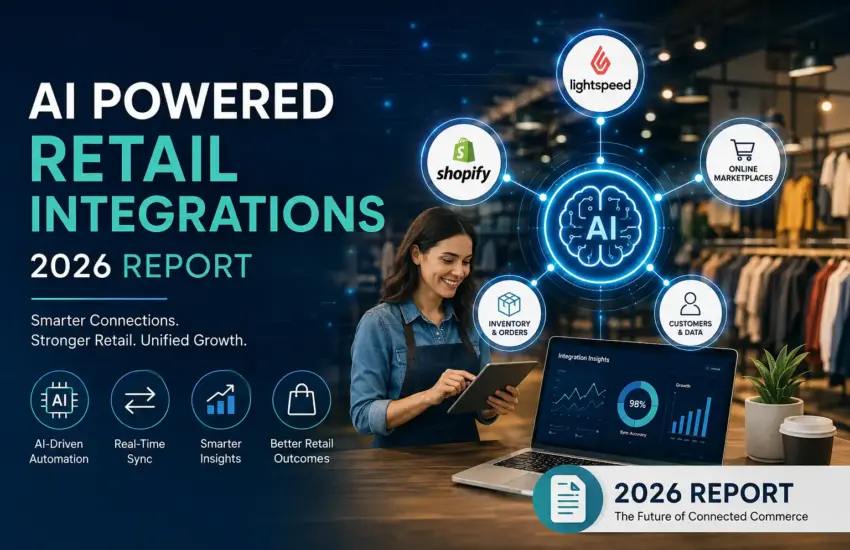
Executive Summary
AI Powered Retail Integrations 2026 examines how artificial intelligence is transforming POS systems, eCommerce platforms, inventory management, and omnichannel retail operations through intelligent automation. Traditional integrations between Point of Sale (POS), eCommerce platforms, Enterprise Resource Planning (ERP), Customer Relationship Management (CRM), and inventory management systems are evolving from simple data synchronization tools into intelligent operational platforms capable of making real-time decisions.
AI-powered retail integrations are enabling businesses to automate repetitive processes, improve inventory accuracy, predict customer demand, optimize order routing, detect operational anomalies, and deliver highly personalized shopping experiences across every sales channel.
As retailers expand across physical stores, online marketplaces, mobile commerce, and social commerce, maintaining consistent inventory, pricing, customer information, and order fulfillment has become increasingly complex. Artificial intelligence provides the intelligence layer that helps businesses manage this complexity while reducing manual effort and improving operational efficiency.
This report examines how AI is reshaping retail integrations, the technologies driving this transformation, the business benefits retailers can expect, the challenges organizations must overcome, and the emerging trends that are expected to define intelligent commerce over the next several years.
1. Introduction
Retail technology has undergone significant evolution during the past decade. Early retail integrations focused primarily on synchronizing product catalogs and inventory levels between isolated software platforms. While these integrations reduced manual data entry, they remained largely reactive and required substantial human oversight.
Today’s retail environment demands far more sophisticated capabilities. Customers expect real-time inventory visibility, accurate order status, personalized product recommendations, flexible fulfillment options, and consistent shopping experiences regardless of channel.
Meeting these expectations requires systems that can continuously monitor operational data, recognize patterns, identify exceptions, and automatically respond to changing business conditions. Artificial intelligence provides these capabilities by combining predictive analytics, machine learning, automation, and intelligent decision-making with modern integration platforms.
Rather than replacing existing retail systems, AI enhances them by improving how information flows between applications and by automating operational decisions that previously required manual intervention.
As intelligent commerce continues to mature, AI-powered integrations are becoming an essential component of modern retail infrastructure.
2. What Are AI-Powered Retail Integrations in Modern Retail?
AI-powered retail integrations combine traditional software connectivity with artificial intelligence to create intelligent, automated workflows that continuously optimize retail operations. Unlike conventional integrations that simply transfer data between applications, AI-enhanced integrations analyze information, identify patterns, predict outcomes, and initiate appropriate actions with minimal human intervention.
Modern retailers typically operate multiple business systems, including Point of Sale (POS), eCommerce platforms, inventory management software, Enterprise Resource Planning (ERP), Customer Relationship Management (CRM), Warehouse Management Systems (WMS), accounting software, payment gateways, shipping providers, and online marketplaces. AI serves as an intelligence layer across these connected systems, enabling them to work together more efficiently.
For example, instead of merely synchronizing inventory between a POS system and an online store, an AI-powered integration can identify unusual sales activity, forecast inventory shortages, recommend replenishment quantities, detect synchronization failures, and automatically notify staff before operational issues affect customers.
These capabilities allow retailers to shift from reactive operations to proactive decision-making, reducing manual effort while improving business performance.
Core Characteristics of AI-Powered Retail Integrations
Intelligent Decision-Making
Artificial intelligence analyzes operational data in real time and recommends or executes actions based on predefined business objectives. This enables faster and more consistent decision-making across retail operations.
Predictive Analytics
Machine learning algorithms evaluate historical sales data, customer behaviour, inventory movement, and seasonal trends to forecast future demand, allowing retailers to prepare for changing market conditions.
Workflow Automation
Routine operational activities such as inventory synchronization, order processing, exception handling, customer notifications, and product updates can be automated, allowing employees to focus on higher-value activities.
Continuous Monitoring
AI continuously monitors connected systems to detect synchronization failures, unusual inventory movements, pricing discrepancies, delayed orders, and other operational anomalies before they become significant business problems.
Adaptive Learning
Unlike traditional rule-based integrations, AI-powered systems improve over time by learning from historical outcomes and adjusting recommendations based on changing business conditions.
Traditional Integration vs AI-Powered Integration
| Traditional Integration | AI-Powered Integration |
|---|---|
| Transfers data between systems | Understands and interprets data |
| Operates using fixed rules | Learns from historical patterns |
| Requires manual exception handling | Automatically identifies and resolves many exceptions |
| Reactive operations | Predictive and proactive operations |
| Limited automation | Intelligent end-to-end automation |
| Human-driven decisions | AI-assisted decision support |
Business Applications
Retail organizations are increasingly applying AI-powered integrations to:
- Inventory forecasting and replenishment
- Product catalogue synchronization
- Intelligent order routing
- Customer segmentation
- Dynamic pricing support
- Fraud detection
- Demand forecasting
- Returns management
- Omnichannel inventory visibility
- Automated customer communication
Rather than functioning as isolated software connectors, AI-powered integrations are becoming operational intelligence platforms that continuously optimize retail processes while supporting business growth.
3. Emerging AI-Powered Retail Integrations
Artificial intelligence has evolved from an emerging technology into a strategic business capability for modern retailers. As retail operations become increasingly digital and interconnected, organizations are seeking intelligent solutions that improve efficiency, reduce costs, and enable better decision-making across their entire technology ecosystem.
Several market forces are driving this transition.
Rising Customer Expectations
Today’s consumers expect seamless shopping experiences regardless of whether they purchase through physical stores, eCommerce websites, mobile applications, marketplaces, or social commerce platforms. They expect accurate inventory availability, real-time order tracking, personalized recommendations, flexible delivery options, and consistent pricing across every channel.
Meeting these expectations requires continuous synchronization between multiple retail systems. AI-powered integrations help retailers maintain data consistency while automatically responding to changing customer behavior and operational conditions.
Increasing Omnichannel Complexity
Retail businesses rarely operate through a single sales channel. Most organizations now manage multiple physical stores, branded eCommerce websites, third-party marketplaces, social commerce platforms, and mobile applications simultaneously.
Each additional channel increases the complexity of synchronizing products, inventory, customer records, pricing, promotions, and order fulfillment.
AI-powered integrations reduce this complexity by automating synchronization, identifying inconsistencies before they affect customers, and optimizing data flows across connected platforms.
Labor Shortages and Operational Efficiency
Retailers continue to face increasing labor costs and shortages of experienced operational staff. Manual data entry, repetitive inventory updates, order verification, and exception management consume valuable employee time while increasing the likelihood of human error.
Artificial intelligence enables organizations to automate routine operational activities, allowing employees to focus on customer service, merchandising, and strategic business initiatives.
Automation also improves operational consistency by ensuring standardized workflows across multiple locations.
Growing Data Volumes
Modern retail systems generate significant amounts of operational data, including sales transactions, customer interactions, inventory movements, website behavior, loyalty activity, shipping updates, and payment records.
Traditional reporting methods often struggle to extract meaningful insights from these large datasets.
AI-powered integrations continuously analyze operational information, identify emerging trends, detect anomalies, and generate actionable recommendations that support faster business decisions.
Demand for Real-Time Decision Making
Retail decisions increasingly need to be made within minutes rather than days. Inventory shortages, unexpected sales spikes, pricing discrepancies, and fulfillment delays require immediate action to minimize customer impact.
Artificial intelligence continuously evaluates operational conditions and provides retailers with near real-time insights, allowing businesses to respond quickly before small issues become significant operational problems.
Competitive Pressure
Retail technology continues to evolve rapidly. Organizations that successfully leverage automation and artificial intelligence can improve customer satisfaction, reduce operational costs, increase inventory accuracy, and accelerate business growth.
As intelligent retail platforms become more widely available, businesses that continue relying exclusively on manual processes risk falling behind competitors that operate with greater efficiency and better customer experiences.
Regulatory and Security Requirements
Retailers must comply with increasing data privacy regulations, payment security standards, and operational governance requirements. AI-powered monitoring systems assist organizations by detecting unusual activity, identifying potential compliance issues, and supporting continuous operational auditing across connected systems.
Although human oversight remains essential, AI significantly improves the speed and consistency of operational monitoring.
Key Business Drivers
The primary reasons retailers are investing in AI-powered integrations include:
- Reducing manual operational workload
- Improving inventory accuracy
- Enhancing omnichannel customer experiences
- Accelerating decision-making
- Increasing operational scalability
- Optimizing fulfillment processes
- Supporting business growth
- Improving data quality
- Reducing operational costs
- Strengthening business resilience
Rather than viewing AI as a replacement for employees, successful retailers are increasingly adopting it as a decision-support technology that enhances operational efficiency while allowing teams to focus on higher-value business activities.
4. Key AI Use Cases in Retail Integrations
Artificial intelligence is no longer limited to predictive analytics or customer recommendations. It is increasingly embedded within retail integration platforms, enabling businesses to automate routine operations, improve decision-making, and respond to operational events in real time. As AI capabilities mature, retailers are applying intelligent integrations across nearly every stage of the retail value chain.
The following use cases illustrate where AI-powered retail integrations are delivering measurable business value.
4.1 Intelligent Inventory Synchronization
Maintaining accurate inventory across physical stores, eCommerce websites, marketplaces, and warehouses remains one of the most significant challenges for modern retailers.
Traditional integrations simply synchronize inventory quantities whenever a transaction occurs. While effective under normal conditions, they often struggle with synchronization delays, duplicate updates, disconnected systems, and unexpected transaction failures.
AI-powered integrations continuously monitor inventory behaviour, identify unusual patterns, predict potential stock shortages, detect synchronization anomalies, and recommend corrective actions before customers are affected.
Typical capabilities include:
- Predicting inventory shortages before they occur
- Detecting abnormal stock movements
- Identifying synchronization failures
- Recommending replenishment priorities
- Reducing overselling and stockouts
4.2 Predictive Demand Forecasting
Historical sales reports provide valuable insights into past performance but offer limited support for future planning.
Artificial intelligence combines historical sales data with seasonality, promotions, customer purchasing behaviour, weather patterns, holidays, and regional demand to generate more accurate demand forecasts.
Improved forecasting enables retailers to:
- Optimize purchasing decisions
- Reduce excess inventory
- Improve product availability
- Minimize lost sales
- Support better cash flow management
Predictive forecasting becomes increasingly valuable for retailers managing multiple locations and diverse product categories.
4.3 Intelligent Order Routing
Retailers frequently fulfil customer orders from multiple locations, including retail stores, warehouses, distribution centres, and third-party logistics providers.
AI-powered integrations automatically evaluate factors such as:
- Inventory availability
- Customer location
- Shipping costs
- Delivery timelines
- Warehouse capacity
- Store workload
Based on these variables, the system recommends or automatically selects the most efficient fulfilment location.
Benefits include:
- Faster delivery
- Lower shipping costs
- Better inventory utilization
- Improved customer satisfaction
4.4 Automated Product Information Management
Maintaining consistent product information across multiple sales channels requires continuous updates to descriptions, pricing, categories, images, specifications, and inventory attributes.
AI assists retailers by:
- Detecting incomplete product information
- Standardizing product descriptions
- Suggesting category assignments
- Identifying duplicate products
- Improving search optimization
- Enhancing product discoverability
These capabilities significantly reduce manual catalogue management while improving customer experience.
4.5 AI-Assisted Customer Support
Modern retailers increasingly integrate conversational AI with customer relationship management systems and eCommerce platforms.
These integrations allow AI assistants to:
- Track customer orders
- Answer frequently asked questions
- Recommend products
- Process returns
- Escalate complex issues to human agents
- Provide 24-hour customer support
Rather than replacing customer service representatives, AI improves response times while allowing staff to focus on more complex customer interactions.
4.6 Fraud Detection and Risk Monitoring
Retail businesses process thousands of financial transactions every day. Detecting fraudulent behaviour manually is becoming increasingly difficult.
AI-powered integrations continuously monitor transactions and identify unusual patterns, including:
- Abnormal purchasing behaviour
- Suspicious refund activity
- Repeated payment failures
- Account misuse
- Inventory manipulation
- Pricing anomalies
Early detection reduces financial losses while improving operational security.
4.7 Personalized Customer Experiences
Artificial intelligence enables retailers to deliver highly personalized shopping experiences by analysing customer preferences, browsing behaviour, purchase history, loyalty activity, and engagement patterns.
AI-powered integrations support:
- Personalized product recommendations
- Dynamic promotional offers
- Customer segmentation
- Individualized marketing campaigns
- Cross-selling opportunities
- Loyalty programme optimization
These capabilities improve customer engagement while increasing average order value and repeat purchases.
4.8 Intelligent Operational Monitoring
Retail operations depend on multiple interconnected software platforms. Even minor synchronization failures can affect inventory accuracy, order processing, customer communications, and financial reporting.
AI-powered monitoring continuously evaluates operational performance across connected systems.
Typical monitoring capabilities include:
- API performance monitoring
- Integration health checks
- Synchronization failure detection
- Performance anomaly identification
- Automated operational alerts
- Root cause analysis
Continuous monitoring improves system reliability while reducing downtime and operational disruption.
Key Takeaways
AI-powered retail integrations extend far beyond simple system connectivity. They provide intelligent decision support, predictive analytics, workflow automation, and continuous operational monitoring that enable retailers to operate more efficiently in increasingly complex omnichannel environments.
Organizations that strategically adopt these capabilities are better positioned to improve customer experiences, optimize operations, reduce costs, and adapt to future changes in retail technology.
5. AI Across the Retail Technology Ecosystem
Artificial intelligence delivers its greatest value when it operates across the entire retail technology ecosystem rather than within isolated software applications. Modern retailers rely on numerous interconnected systems to manage sales, inventory, customer relationships, financial operations, logistics, marketing, and business intelligence. AI-powered integrations enable these systems to exchange information intelligently, automate business processes, and support real-time operational decision-making.
Instead of treating each platform as an independent application, AI creates a connected ecosystem where information flows continuously, enabling retailers to operate with greater efficiency, accuracy, and agility.
5.1 Point of Sale (POS) Systems
The Point of Sale system remains the operational centre of most retail businesses. Every customer transaction, inventory adjustment, product return, exchange, and payment generates valuable business data.
AI-powered integrations enhance POS systems by:
- Monitoring sales patterns in real time.
- Detecting unusual purchasing behaviour.
- Forecasting inventory requirements.
- Recommending replenishment quantities.
- Identifying pricing inconsistencies.
- Supporting dynamic promotional strategies.
By analysing transaction data continuously, AI transforms the POS system from a transaction-processing tool into an operational intelligence platform.
5.2 eCommerce Platforms
Online stores generate large volumes of behavioural and transactional data, including browsing activity, abandoned carts, customer preferences, product searches, and purchasing patterns.
AI-powered integrations improve eCommerce operations by:
- Personalizing product recommendations.
- Optimizing search results.
- Predicting customer intent.
- Automating merchandising decisions.
- Synchronizing inventory in real time.
- Supporting dynamic pricing strategies.
These capabilities improve customer engagement while increasing conversion rates and average order values.
5.3 Customer Relationship Management (CRM)
CRM platforms contain valuable customer information, including purchase history, communication preferences, loyalty participation, and service interactions.
Artificial intelligence enables CRM systems to:
- Segment customers automatically.
- Predict customer lifetime value.
- Identify customers at risk of churn.
- Recommend personalized marketing campaigns.
- Improve customer retention strategies.
- Automate follow-up communications.
Retailers can therefore deliver more relevant and timely customer experiences across every sales channel.
5.4 Enterprise Resource Planning (ERP)
ERP systems manage purchasing, finance, procurement, supplier relationships, inventory valuation, and operational planning.
AI-powered integrations strengthen ERP capabilities by:
- Forecasting purchasing requirements.
- Optimizing supplier selection.
- Predicting stock availability.
- Improving financial forecasting.
- Identifying operational bottlenecks.
- Detecting unusual procurement activity.
These improvements support better resource planning and more informed business decisions.
5.5 Warehouse Management Systems (WMS)
Warehouses have become increasingly complex as retailers support same-day delivery, ship-from-store, click-and-collect, and marketplace fulfilment.
AI assists warehouse operations by:
- Optimizing picking routes.
- Predicting warehouse congestion.
- Improving inventory placement.
- Prioritizing order fulfilment.
- Reducing fulfilment errors.
- Supporting labour planning.
These capabilities improve operational efficiency while reducing delivery times.
5.6 Accounting and Financial Systems
Accounting systems process large volumes of operational and financial information generated throughout retail operations.
AI-powered integrations assist by:
- Automatically reconciling transactions.
- Detecting accounting anomalies.
- Identifying duplicate payments.
- Supporting financial forecasting.
- Monitoring operational profitability.
- Improving audit readiness.
These capabilities reduce manual effort while improving financial accuracy.
5.7 Payment Platforms
Payment systems play a critical role in customer trust and operational security.
AI strengthens payment operations through:
- Real-time fraud detection.
- Risk scoring.
- Payment authorization analysis.
- Chargeback prediction.
- Suspicious transaction monitoring.
- Payment performance analytics.
This improves both security and customer confidence.
5.8 Marketing Automation Platforms
Marketing platforms increasingly rely on artificial intelligence to deliver highly targeted customer communications.
AI-powered integrations enable:
- Personalized email campaigns.
- Audience segmentation.
- Campaign optimization.
- Customer journey automation.
- Promotional recommendations.
- Marketing performance analysis.
These capabilities improve engagement while reducing marketing costs.
5.9 Business Intelligence and Analytics
Retail organizations collect significant amounts of operational data, but deriving meaningful insights remains challenging without advanced analytics.
AI-powered integrations enhance business intelligence by:
- Identifying emerging sales trends.
- Forecasting future performance.
- Detecting operational anomalies.
- Generating executive dashboards.
- Producing automated business reports.
- Supporting strategic planning.
Rather than simply presenting historical information, AI provides predictive insights that help retailers make better business decisions.
Building an Intelligent Retail Ecosystem
The future of retail technology lies not in deploying additional software platforms, but in enabling existing systems to work together more intelligently. AI-powered integrations create a unified operational environment where data flows seamlessly across POS, eCommerce, CRM, ERP, WMS, accounting, payment, and marketing systems.
By eliminating information silos and automating operational decision-making, retailers can improve inventory accuracy, enhance customer experiences, reduce manual workload, and respond more effectively to changing market conditions.
As artificial intelligence continues to mature, integrated retail ecosystems will become increasingly autonomous, enabling businesses to focus less on routine operational tasks and more on innovation, customer relationships, and sustainable growth.
6. Benefits of AI-Powered Retail Integrations
The adoption of artificial intelligence in retail integration is no longer driven solely by technological innovation. Retailers are increasingly investing in AI because it delivers measurable business outcomes across operations, customer engagement, inventory management, and long-term strategic planning.
Organizations that successfully implement AI-powered integrations can improve efficiency, reduce costs, enhance customer experiences, and build more resilient retail operations.
6.1 Improved Operational Efficiency
Manual processes remain one of the largest sources of operational inefficiency in retail. Employees often spend significant time updating inventory, processing orders, correcting synchronization errors, managing product information, and preparing reports.
AI-powered integrations automate these repetitive activities by continuously synchronizing data, monitoring system performance, and initiating predefined workflows.
Benefits include:
- Reduced manual data entry
- Faster order processing
- Fewer operational bottlenecks
- Improved employee productivity
- More efficient use of business resources
By reducing routine administrative tasks, employees can focus on customer service, merchandising, and business growth initiatives.
6.2 Better Inventory Accuracy
Accurate inventory information is essential for maintaining customer confidence and supporting efficient retail operations.
Artificial intelligence continuously monitors inventory levels across connected systems and identifies discrepancies before they become operational problems.
Retailers benefit from:
- Reduced stockouts
- Lower overselling risk
- Improved replenishment planning
- Better inventory visibility
- More accurate inventory forecasting
Improved inventory accuracy also contributes directly to higher customer satisfaction and lower operational costs.
6.3 Faster Business Decision-Making
Traditional retail reporting often focuses on historical performance. While useful, historical reports provide limited support for responding to rapidly changing market conditions.
AI-powered integrations continuously analyse operational data and generate actionable insights in near real time.
Decision-makers can respond more quickly to:
- Unexpected demand fluctuations
- Inventory shortages
- Pricing inconsistencies
- Supplier delays
- Customer purchasing trends
- Operational exceptions
This enables retailers to make proactive decisions rather than reacting after problems have already affected business performance.
6.4 Enhanced Customer Experience
Customer expectations continue to evolve as retailers expand across multiple sales channels.
AI-powered integrations improve customer experiences by supporting:
- Accurate product availability
- Faster order fulfilment
- Personalized recommendations
- Consistent pricing
- Real-time order tracking
- Efficient returns management
Providing reliable and consistent experiences across both physical and digital channels strengthens customer loyalty and encourages repeat purchases.
6.5 Reduced Operational Costs
Operational inefficiencies often result in unnecessary labour expenses, inventory losses, delayed fulfilment, and customer service overhead.
AI reduces operational costs by:
- Automating repetitive workflows
- Preventing inventory errors
- Reducing manual exception handling
- Improving fulfilment efficiency
- Supporting better purchasing decisions
Although implementing AI requires initial investment, many retailers achieve long-term savings through improved operational performance.
6.6 Increased Scalability
As retail businesses grow, the complexity of managing additional stores, warehouses, online channels, marketplaces, and suppliers increases significantly.
Traditional manual processes rarely scale efficiently.
AI-powered integrations enable retailers to:
- Expand into new sales channels
- Manage larger product catalogues
- Support additional business locations
- Handle increasing transaction volumes
- Maintain operational consistency
Scalable integrations allow organizations to grow without proportionally increasing operational workload.
6.7 Improved Data Quality
Business decisions depend upon accurate and consistent information.
Artificial intelligence continuously validates data flowing between connected systems and identifies:
- Missing product information
- Duplicate customer records
- Pricing inconsistencies
- Synchronization failures
- Incomplete transactions
- Invalid inventory updates
Improved data quality strengthens reporting, forecasting, and overall business decision-making.
6.8 Stronger Risk Management
Retail operations face numerous operational and financial risks, including system failures, inventory discrepancies, fraud, cybersecurity threats, and supply chain disruptions.
AI-powered monitoring assists retailers by:
- Detecting unusual operational behaviour
- Identifying security risks
- Monitoring system performance
- Recognizing integration failures
- Supporting compliance monitoring
Early detection allows organizations to respond before minor issues develop into significant business disruptions.
6.9 Competitive Advantage
Artificial intelligence enables retailers to operate with greater agility than organizations relying exclusively on manual processes.
Retailers using AI-powered integrations can:
- Respond faster to market changes
- Improve customer satisfaction
- Reduce operational costs
- Launch new services more quickly
- Deliver more personalized shopping experiences
These capabilities contribute to stronger competitive positioning in increasingly dynamic retail markets.
Key Business Benefits
Organizations implementing AI-powered retail integrations can expect improvements across multiple areas:
- Higher operational efficiency
- Better inventory accuracy
- Faster decision-making
- Enhanced customer experiences
- Reduced operating costs
- Greater business scalability
- Improved data quality
- Stronger operational resilience
- Better risk management
- Sustainable competitive advantage
While implementation approaches vary between organizations, the underlying objective remains consistent: enabling retailers to make better business decisions through intelligent automation, connected systems, and data-driven operations.
7. Challenges and Implementation Considerations
While artificial intelligence offers significant opportunities for improving retail operations, successful implementation requires careful planning, realistic expectations, and strong organizational readiness. AI-powered integrations are not standalone solutions; they depend on reliable data, well-designed business processes, secure technology infrastructure, and ongoing governance.
Retailers that recognize these challenges early are better positioned to maximize the value of their AI investments while minimizing operational risks.
7.1 Data Quality and Consistency
Artificial intelligence is only as effective as the quality of the data it receives. Inaccurate inventory records, duplicate customer profiles, inconsistent product catalogues, and incomplete transaction histories can reduce the accuracy of AI-generated recommendations.
Before implementing AI-powered integrations, retailers should ensure that:
- Product information is standardized.
- Inventory records are accurate.
- Customer data is complete and consistent.
- Duplicate records are eliminated.
- Business rules are clearly defined.
Establishing strong data governance provides a solid foundation for reliable AI-driven decision-making.
7.2 Legacy Systems and Integration Complexity
Many retailers continue to operate legacy POS systems, proprietary software, or custom-built applications that were not designed to support modern API-based integrations.
Connecting these systems with contemporary AI platforms may require:
- Middleware solutions
- Custom APIs
- Data transformation processes
- Incremental modernization strategies
Organizations should assess their existing technology landscape before introducing AI capabilities to avoid unnecessary complexity and implementation delays.
7.3 Cybersecurity and Data Privacy
AI-powered integrations exchange information across multiple business systems, increasing the importance of protecting sensitive operational and customer data.
Retailers should implement:
- Secure API authentication
- Encryption of data in transit and at rest
- Role-based access controls
- Continuous security monitoring
- Compliance with applicable privacy regulations
Security should be considered throughout the implementation lifecycle rather than as a post-deployment activity.
7.4 Organizational Change Management
Introducing AI often changes established workflows and employee responsibilities. Without appropriate communication and training, staff may be reluctant to adopt new technologies.
Successful implementations typically include:
- Employee awareness programmes
- Hands-on training
- Clearly documented workflows
- Ongoing technical support
- Leadership commitment to digital transformation
AI should be presented as a tool that enhances employee productivity rather than replacing human expertise.
7.5 Implementation Costs
Deploying AI-powered integrations involves both direct and indirect investments.
Potential cost considerations include:
- Software licensing
- Integration development
- Infrastructure upgrades
- Data preparation
- Employee training
- Ongoing system maintenance
Retailers should evaluate long-term business value rather than focusing solely on initial implementation costs.
7.6 AI Governance and Human Oversight
Artificial intelligence can automate many operational decisions, but it should not operate without appropriate oversight.
Organizations should establish governance frameworks that define:
- Human approval requirements
- Exception handling procedures
- Performance monitoring
- Decision accountability
- Periodic model evaluation
Maintaining human involvement in strategic and high-impact decisions helps ensure responsible and transparent use of AI.
7.7 Vendor Selection and Technology Compatibility
Selecting technology partners is a critical implementation decision.
Retailers should evaluate vendors based on:
- API capabilities
- Scalability
- Security practices
- Industry expertise
- Integration experience
- Customer support
- Long-term product roadmap
Choosing technology partners with proven retail experience can significantly reduce implementation risks.
7.8 Measuring Return on Investment (ROI)
Organizations should define measurable success indicators before implementation begins.
Common performance metrics include:
- Inventory accuracy
- Order processing time
- Stockout frequency
- Fulfilment efficiency
- Customer satisfaction
- Labour productivity
- Operational cost savings
Regular performance reviews help retailers evaluate whether AI-powered integrations are delivering expected business outcomes.
Best Practices for Successful Implementation
Retailers planning AI-powered integrations should consider the following recommendations:
- Begin with clearly defined business objectives.
- Improve data quality before deploying AI.
- Start with pilot projects before large-scale implementation.
- Select scalable, API-first technology platforms.
- Train employees throughout the implementation process.
- Monitor system performance continuously.
- Review AI recommendations regularly.
- Maintain strong cybersecurity practices.
- Establish governance policies for responsible AI usage.
Key Considerations
Successful AI adoption depends on balancing technological innovation with sound business practices. Organizations that invest in clean data, secure infrastructure, employee readiness, and continuous improvement are more likely to achieve sustainable long-term benefits.
Rather than viewing AI as a one-time technology project, retailers should treat intelligent integration as an ongoing business capability that evolves alongside customer expectations, operational requirements, and emerging technologies.
8. Future of AI Powered Retail Integrations (2026–2030)
Artificial intelligence is expected to become a foundational component of retail operations over the next five years. While today’s AI applications primarily assist retailers by automating repetitive tasks and improving operational visibility, the next generation of intelligent retail systems will increasingly support autonomous decision-making, predictive operations, and continuous business optimization.
Rather than simply connecting software applications, future retail integrations will function as intelligent digital ecosystems capable of learning, adapting, and responding to changing business conditions with minimal human intervention.
Several emerging trends are expected to shape this transformation.
8.1 Autonomous Retail Operations
Retail operations are gradually moving from manual workflows to autonomous operational management.
Future AI-powered integration platforms will increasingly perform tasks such as:
- Inventory replenishment
- Order prioritization
- Product categorization
- Exception handling
- Supplier communication
- Operational reporting
without requiring continuous human involvement.
Human teams will remain responsible for strategic decisions, while AI manages routine operational activities.
8.2 AI Agents for Retail Operations
AI agents are expected to become an important component of modern retail technology.
Unlike traditional automation tools that follow predefined rules, AI agents can understand objectives, analyse operational conditions, make recommendations, and execute multi-step workflows.
Future retail AI agents may assist with:
- Inventory planning
- Supplier coordination
- Customer support
- Product information management
- Marketing campaign optimization
- Operational performance monitoring
These intelligent assistants will enable retailers to manage increasingly complex operations more efficiently.
8.3 Predictive Commerce
Retailers have traditionally responded to customer demand after purchasing behaviour becomes visible.
Predictive commerce changes this approach by anticipating future customer requirements before transactions occur.
Artificial intelligence will increasingly analyse:
- Customer purchasing behaviour
- Seasonal demand
- Regional buying patterns
- Product lifecycle trends
- Market conditions
to support proactive inventory planning, pricing strategies, and merchandising decisions.
This shift from reactive to predictive retailing is expected to improve both customer satisfaction and operational efficiency.
8.4 Hyper-Personalized Customer Experiences
Customers increasingly expect shopping experiences that reflect their individual preferences and purchasing behavior.
Future AI-powered integrations will enable retailers to deliver:
- Individualized product recommendations
- Personalized promotions
- Dynamic pricing strategies
- Context-aware marketing campaigns
- Intelligent loyalty programs
- Customized shopping journeys
These capabilities will strengthen customer engagement while supporting long-term brand loyalty.
8.5 Self-Healing Integrations
Traditional integrations require technical teams to monitor synchronization failures and resolve operational issues manually.
Future integration platforms are expected to become increasingly self-healing by automatically:
- Detecting synchronization failures
- Identifying root causes
- Restarting failed processes
- Correcting data inconsistencies
- Alerting operational teams only when human intervention is required
This will significantly improve system reliability while reducing operational downtime.
8.6 Digital Twins for Retail Operations
Digital twins create virtual representations of physical retail operations.
Future retailers may use digital twins to simulate:
- Inventory movement
- Store operations
- Customer traffic
- Warehouse performance
- Supply chain disruptions
- Promotional campaigns
before implementing operational changes in real environments.
This enables organizations to evaluate potential business outcomes while minimizing operational risk.
8.7 Responsible and Ethical AI
As AI becomes increasingly embedded within retail operations, organizations will place greater emphasis on responsible AI governance.
Future AI implementations will require:
- Transparency in automated decisions
- Human oversight
- Data privacy protection
- Bias mitigation
- Regulatory compliance
- Ethical use of customer information
Retailers that establish strong AI governance frameworks will be better positioned to maintain customer trust while meeting evolving regulatory requirements.
8.8 The Future Role of Retail Technology Partners
The role of retail technology partners is also expected to evolve.
Rather than simply implementing software integrations, technology providers will increasingly assist retailers by:
- Designing AI-enabled operational architectures
- Optimizing business workflows
- Supporting digital transformation initiatives
- Advising on AI governance
- Monitoring operational performance
- Delivering continuous innovation
Long-term partnerships focused on business outcomes will become more valuable than one-time technology deployments.
Looking Ahead
Artificial intelligence is reshaping the future of retail by transforming integrations into intelligent business platforms capable of learning, adapting, and continuously optimizing operations.
Retailers that begin preparing today by modernizing their technology infrastructure, improving data quality, strengthening integration capabilities, and developing AI readiness will be better positioned to compete in an increasingly connected and data-driven retail environment.
The evolution of intelligent commerce is no longer a distant possibility—it is already underway. Organizations that combine strong operational foundations with responsible AI adoption will be best equipped to meet changing customer expectations and achieve sustainable long-term growth.
9. Conclusion and Strategic Recommendations
Artificial intelligence is fundamentally changing how retailers manage operations, connect business systems, and serve customers. What began as basic system integration has evolved into intelligent operational ecosystems capable of supporting predictive analytics, workflow automation, real-time monitoring, and data-driven decision-making.
Throughout this report, we have examined how AI-powered retail integrations extend beyond traditional data synchronization. By combining artificial intelligence with modern integration platforms, retailers can improve inventory accuracy, streamline order fulfilment, strengthen customer engagement, reduce operational costs, and create more resilient omnichannel operations.
However, successful implementation requires more than adopting new technology. Retailers must establish reliable data foundations, modern integration architectures, effective governance frameworks, and a culture that embraces continuous improvement. Organizations that approach AI strategically rather than tactically are more likely to achieve sustainable long-term value.
As the retail industry continues to evolve, AI-powered integrations will increasingly become a competitive necessity rather than a technological advantage. Businesses that begin preparing today will be better positioned to respond to changing customer expectations, support future growth, and adapt to an increasingly intelligent retail environment.
Strategic Recommendations
Based on the findings presented throughout this report, Retail Matchmaker recommends that retailers consider the following strategic priorities when planning AI-powered integration initiatives.
1. Establish Clear Business Objectives
Artificial intelligence should support clearly defined business goals rather than being implemented simply because the technology is available.
Retailers should identify measurable objectives such as:
- Improving inventory accuracy.
- Reducing fulfilment times.
- Increasing operational efficiency.
- Enhancing customer experience.
- Lowering operational costs.
Clearly defined objectives provide a framework for measuring implementation success.
2. Build a Strong Data Foundation
Reliable AI depends upon reliable data.
Organizations should prioritise:
- Accurate product catalogues.
- Clean customer records.
- Standardised inventory information.
- Consistent business rules.
- Reliable operational reporting.
Improving data quality before deploying AI significantly increases the effectiveness of intelligent integrations.
3. Modernize Integration Architecture
Retailers should adopt scalable, API-first integration architectures capable of supporting future business growth.
Modern integration platforms should provide:
- Real-time data exchange.
- Secure API connectivity.
- Flexible workflow automation.
- Scalable cloud infrastructure.
- Continuous monitoring capabilities.
This foundation enables future AI capabilities to be introduced more efficiently.
4. Begin with High-Impact Use Cases
Rather than attempting enterprise-wide AI deployment immediately, organizations should begin with operational areas where measurable improvements can be achieved quickly.
Examples include:
- Inventory synchronization.
- Demand forecasting.
- Order routing.
- Customer support automation.
- Product catalogue management.
Early success builds organizational confidence while reducing implementation risk.
5. Invest in Employee Readiness
Technology alone cannot transform retail operations.
Successful AI adoption requires:
- Staff training.
- Process documentation.
- Leadership support.
- Change management.
- Continuous learning.
Employees should view AI as a decision-support capability that enhances their effectiveness rather than replacing human expertise.
6. Strengthen Governance and Security
As AI becomes increasingly integrated into business operations, organizations should establish governance policies covering:
- Data privacy.
- Cybersecurity.
- Human oversight.
- Decision accountability.
- Regulatory compliance.
- Continuous performance monitoring.
Responsible AI governance will become increasingly important as regulatory requirements continue to evolve.
7. View AI as a Long-Term Capability
Artificial intelligence should not be treated as a one-time implementation project.
Retailers should establish a roadmap for continuous improvement that includes:
- Regular technology reviews.
- Performance measurement.
- Ongoing optimization.
- Expansion into additional business functions.
- Adoption of emerging AI capabilities.
Organizations that continuously refine their intelligent integration strategies will be better positioned to maintain long-term competitive advantage.
Final Thoughts
Artificial intelligence is no longer an emerging concept within retail technology. It is becoming a practical business capability that enables organizations to connect systems more intelligently, automate routine operations, improve customer experiences, and make faster, data-driven decisions.
While every retailer’s digital transformation journey will differ, the underlying principle remains consistent: intelligent integrations are most effective when they align technology with business strategy.
Retailers that invest today in modern integration platforms, high-quality data, responsible AI governance, and continuous innovation will be better prepared for the next generation of intelligent commerce.
Need Help Implementing AI-Powered Retail Integrations?
Reading industry research is the first step. If your business is planning AI-powered retail integration, Retail Matchmaker can help you evaluate technology options, design integration strategies, and optimize omnichannel operations.
About Retail Matchmaker
Retail Matchmaker is a retail technology consultancy specializing in retail system integrations, AI-powered automation, Lightspeed Shopify Integration, and omnichannel commerce.
The company helps independent and multi-location retailers simplify omnichannel operations by connecting Lightspeed Retail POS with Shopify, synchronizing inventory, products, orders, and customer data, and reducing manual administrative work through intelligent automation.
Retail Matchmaker is currently developing Connectail, an AI-powered, self-service integration platform designed to make Lightspeed Shopify Integration faster, smarter, and easier to deploy. By combining intelligent onboarding, workflow automation, and AI-assisted operational management, Connectail aims to help retailers implement enterprise-grade integrations with minimal manual intervention.
Learn more about our Lightspeed Shopify Integration services.
References
This report has been prepared using publicly available information, implementation guidance, and industry best practices from authoritative retail technology resources, including:
- Shopify Developer Documentation
- Shopify Help Center
- Lightspeed Developer Portal
- Lightspeed Retail Help Center
- National Retail Federation (NRF)
- U.S. Census Bureau – Monthly Retail Trade
- GS1 Global Standards
- PCI Security Standards Council
- NIST AI Risk Management Framework
- OpenAPI Initiative
- Deloitte Insights – Retail
- McKinsey & Company – Retail