
Lightspeed and Shopify – A Practical Look at AI Sync Conflict Resolution
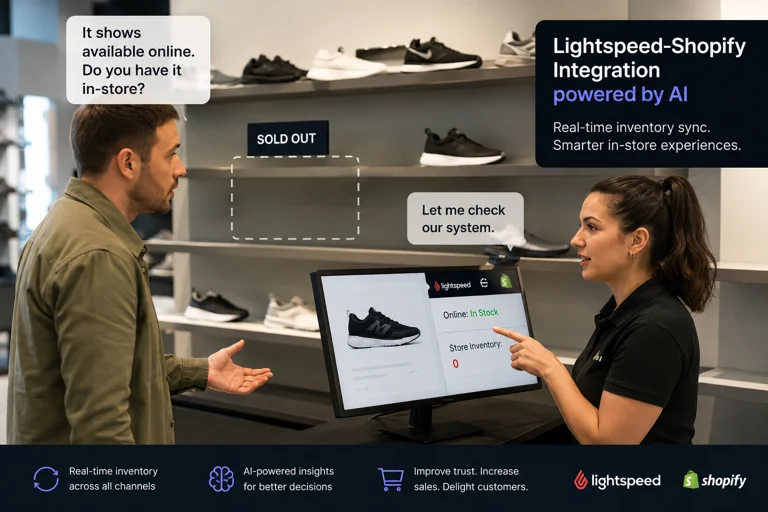
Every retailer running Lightspeed in-store and Shopify online has lived through this moment: a customer walks in asking for a product that shows as available online – but the shelf is empty. Or worse, a sale happens twice because inventory updated in one place but not the other.
This is a sync conflict. And it costs real money.
Why AI Sync Conflict Resolution Sounds Like the Answer
The promise is appealing: let AI watch your data streams, spot mismatches, and fix them without anyone touching a keyboard. And to be fair, AI has gotten smarter at detecting patterns – noticing that a product often sells out on Saturdays, flagging anomalies when stock dips below a threshold, or predicting demand spikes before they cause oversell events.
But here’s what retailers often don’t hear until after they’ve invested: AI can flag conflicts, and it can suggest resolutions, but fully automatic resolution is still a risky proposition for most retail operations.
What AI Actually Does Well in This Space
AI-powered tools can genuinely help in three ways:
First, they reduce the time between a conflict occurring and someone being alerted to it. Instead of discovering a mismatch during a customer complaint, you get a notification the moment inventory numbers diverge between Lightspeed and Shopify.
Second, they can apply rule-based decisions automatically for simple, low-risk conflicts – say, small quantity discrepancies under a defined threshold. These are safe to auto-correct.
Third, they help retailers build smarter sync schedules based on actual sales rhythms rather than fixed time intervals that ignore peak hours.
Where Human Judgment Still Matters
Complex conflicts – price discrepancies, duplicate orders, product variants with mismatched attributes, or bulk receiving errors – still need a human to review before any auto-correction. The cost of a wrong automated decision can be returns, chargebacks, or oversells during your busiest selling window.
This is where advisory matters as much as technology.
A Smarter Path Forward for Lightspeed and Shopify Integration
Retailers serious about making their Lightspeed-to-Shopify integration work reliably need more than a plugin. They need a conflict management strategy: defined sync rules, exception workflows, and the right integration layer underneath.
At Retail Matchmaker, we help retailers move from reactive conflict firefighting to proactive sync management – combining the right middleware with clear operational rules that AI can actually act on safely.
AI sync conflict resolution is a tool, not a strategy. Used correctly, it saves hours. Used blindly, it creates new problems. The retailers winning at omnichannel treat it as one layer in a well-designed integration stack – not a magic fix.

