

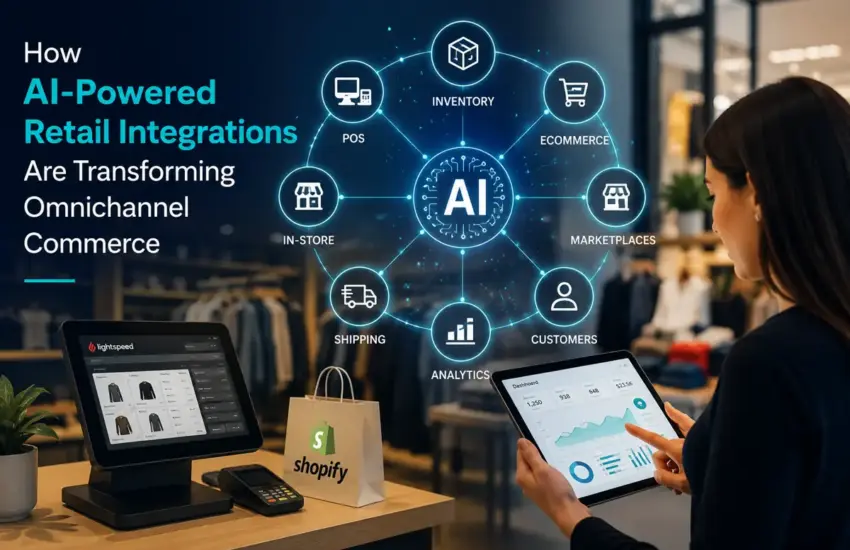
Retail is becoming increasingly connected. Customers expect consistent experiences whether they shop online, visit a physical store, browse on a mobile device, or interact through social commerce. Meeting these expectations requires more than simply connecting a POS system to an eCommerce platform – it requires intelligent integration.
AI-powered retail integrations are helping retailers move beyond basic data synchronization by introducing automation, predictive analytics, and intelligent decision-making into everyday business operations.
Moving Beyond Traditional Integrations
Traditional integrations primarily transfer information between systems. For example, inventory updates may flow from a POS system to an online store, while orders move in the opposite direction.
AI-powered integrations build on this foundation by analysing operational data, identifying patterns, and recommending actions that improve efficiency.
Instead of only moving data, intelligent integrations help retailers understand what that data means.
Smarter Inventory Management
Inventory remains one of the most challenging aspects of retail operations.
Artificial intelligence helps retailers by:
- Predicting future demand.
- Identifying slow-moving inventory.
- Detecting unusual purchasing patterns.
- Reducing stockouts.
- Improving replenishment planning.
These capabilities help retailers maintain better inventory accuracy while reducing unnecessary carrying costs.
Faster Order Processing
Modern consumers expect rapid order fulfilment.
AI-powered integrations can automatically:
- Prioritize incoming orders.
- Route orders to the most appropriate fulfilment location.
- Detect fulfilment exceptions.
- Identify potential shipping delays.
- Recommend alternative inventory sources.
Automating these decisions allows staff to focus on higher-value operational activities.
Improved Customer Experiences
Artificial intelligence also enables retailers to deliver more personalised customer experiences.
Examples include:
- Product recommendations.
- Intelligent search.
- Personalised promotions.
- Customer segmentation.
- Loyalty programme optimisation.
These capabilities help businesses increase customer engagement while strengthening long-term retention.
Supporting Better Business Decisions
Retailers generate large volumes of operational data every day.
AI-powered integrations transform this information into practical insights by analysing trends across inventory, sales, customer behaviour, and operational performance.
Business leaders gain faster access to information that supports better planning and more informed decision-making.
Preparing for the Future
Artificial intelligence is expected to become an increasingly important component of retail technology over the coming years.
Retailers that modernise their integration architecture today will be better positioned to adopt future capabilities such as AI agents, predictive commerce, workflow automation, and autonomous operational management.
Read the Complete Industry Report
This article provides a brief overview of emerging AI integration trends.
For a detailed analysis, implementation considerations, future outlook, and strategic recommendations, read our complete research report:
👉 AI-Powered Retail Integrations 2026: The Future of Intelligent Commerce
Explore More Retail Research
Browse additional independent research covering POS systems, eCommerce, AI, inventory management, and omnichannel retail.
Need Help with Retail Integrations?
Retail Matchmaker helps independent and multi-location retailers connect POS systems, eCommerce platforms, inventory management, and intelligent automation to build scalable omnichannel operations.

