
Lightspeed Shopify Integration Cost (2026): Pricing, Options & What Retailers Should Expect
Introduction
If you’re planning a Lightspeed Shopify Integration, one of the first questions you’ll probably ask is:
“How much does Lightspeed Shopify Integration cost?”
Unfortunately, there isn’t a single answer.
The total investment depends on your retail environment, the number of products you manage, whether you operate one or multiple stores, the type of synchronization you require, and whether you choose a native app, third-party middleware, or a custom-built integration.
Many retailers focus only on monthly subscription fees and overlook the operational costs associated with manual inventory updates, duplicate product management, overselling, delayed order processing, and disconnected customer records. In many cases, these hidden costs are far greater than the cost of implementing the right integration.
This guide explains how Lightspeed Shopify Integration pricing typically works, what factors influence the total cost of ownership, the different pricing models available, and the questions every retailer should ask before selecting an integration solution.
If you’re still exploring how Lightspeed Retail POS and Shopify work together, we recommend reading our Complete Guide to Lightspeed Shopify Integration, which explains the complete integration workflow, inventory synchronization, order management, customer synchronization, and implementation best practices before comparing pricing options.
Whether you’re launching your first Shopify store or managing multiple retail locations, understanding these costs can help you make an informed long-term investment.
In Short
Lightspeed Shopify Integration costs vary depending on your business requirements, synchronization needs, implementation complexity, and the integration solution you choose. Rather than comparing software subscription fees alone, retailers should evaluate the total operational value, long-term scalability, and support provided by the integration.
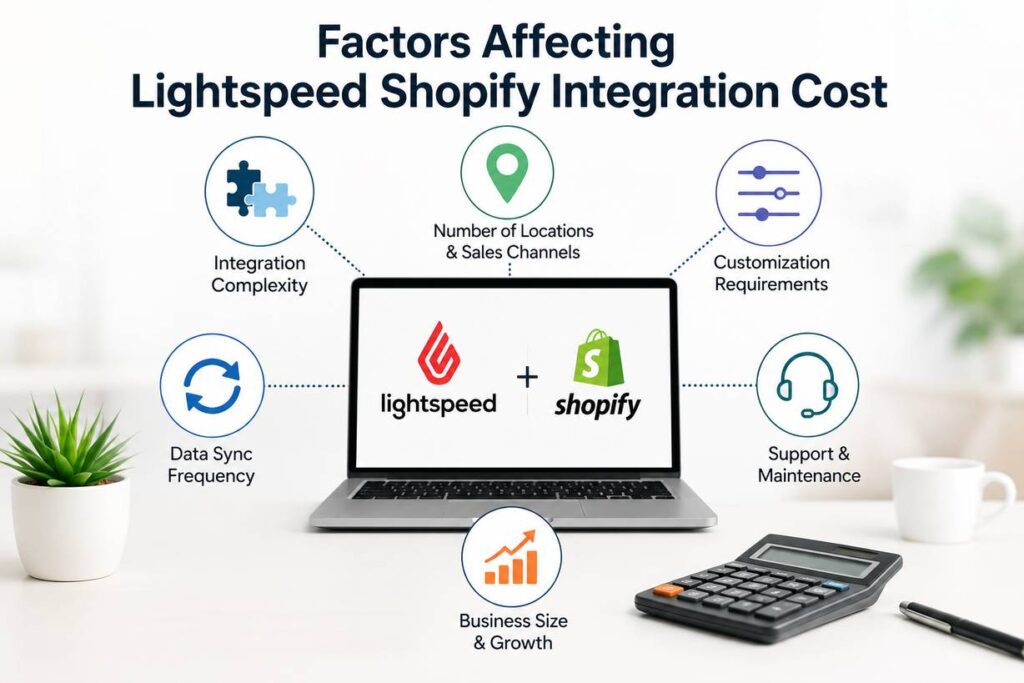
Table of Contents
- Why Retailers Need Lightspeed Shopify Integration
- What Determines Integration Cost?
- Typical Pricing Models
- Native Apps vs Middleware vs Custom Integration
- Hidden Costs Retailers Often Miss
- Is the Cheapest Integration Really the Cheapest?
- Questions to Ask Before Buying
- Choosing the Right Integration Partner
- Frequently Asked Questions
Why Retailers Invest in Lightspeed Shopify Integration
Running a retail business today means serving customers across multiple sales channels.
Many retailers use Lightspeed Retail POS to manage their physical stores while using Shopify to sell online. Without an integration between the two platforms, staff often spend hours manually updating inventory, entering online orders into the POS system, correcting pricing inconsistencies, and resolving customer service issues caused by inaccurate stock information.
If you’re evaluating whether an integration is the right approach for your business, our Lightspeed Shopify Integration guide explains how inventory synchronization, product updates, order downloads, and customer data synchronization work together to create a unified retail operation.
An integration automates these repetitive tasks and helps maintain consistency between in-store and online operations.
Typical synchronization capabilities include:
- Product synchronization
- Inventory synchronization
- Shopify order downloads
- Customer synchronization
- Pricing updates
- Product image synchronization
- Category synchronization
- Variant synchronization
- Multi-location inventory updates
When these processes are automated, retailers spend less time on administrative work and more time serving customers and growing their business.
Key Benefits of Integration
| Business Challenge | Integration Benefit |
|---|---|
| Manual inventory updates | Automated inventory synchronization |
| Duplicate product entry | Single source of product information |
| Overselling online | Improved inventory accuracy |
| Delayed order processing | Automatic order downloads |
| Separate customer databases | Better customer data consistency |
| Multi-store complexity | Centralized inventory management |
| Manual price updates | Faster pricing synchronization |
In Short
Lightspeed Shopify Integration helps retailers reduce manual work, improve inventory accuracy, streamline order processing, and create a more consistent omnichannel shopping experience.
What Determines Lightspeed Shopify Integration Cost?
No two retailers have exactly the same operational requirements.
A small boutique with one store and 500 products has very different integration needs compared to a retailer operating multiple stores with thousands of products, product variants, gift cards, customer loyalty programs, and complex pricing structures.
Several factors influence implementation costs.
1. Number of Products
A larger product catalog generally requires more time for:
- Product mapping
- Data validation
- Category alignment
- Image synchronization
- Variant configuration
Retailers with tens of thousands of SKUs often require additional planning before the integration goes live.
2. Product Variants
Products available in multiple:
- Sizes
- Colours
- Styles
- Materials
increase synchronization complexity.
Proper handling of variants is essential to avoid inventory mismatches between Lightspeed and Shopify.
Retailers experiencing stock discrepancies should also read Why Lightspeed Inventory Doesn’t Sync with Shopify, where we explain the most common causes of synchronization failures and practical ways to prevent them.
3. Number of Store Locations
Retailers operating multiple stores often need inventory synchronization across different locations.
Questions that commonly arise include:
- Should online orders deduct inventory from a specific location?
- Should customers see inventory available at each store?
- Should inventory be reserved automatically?
These business rules can influence implementation effort.
4. Synchronization Frequency
Some retailers are comfortable updating inventory every few hours.
Others require inventory updates within minutes to minimize overselling.
More frequent synchronization generally requires a more sophisticated integration architecture.
5. Order Processing Requirements
Not every retailer manages online orders in the same way.
Some businesses require:
- Automatic Shopify order downloads
- Customer creation in Lightspeed
- Payment mapping
- Tax mapping
- Shipping information
- Discount synchronization
The more business processes that need automation, the more comprehensive the integration becomes.
6. Existing Data Quality
Many implementation projects spend significant time cleaning existing data rather than building the integration itself.
Common issues include:
- Duplicate SKUs
- Missing barcodes
- Inconsistent product names
- Incorrect categories
- Duplicate customers
- Incomplete inventory records
Improving data quality before implementation usually reduces long-term operational issues.
7. Future Growth
An integration should support future expansion.
Questions worth considering include:
- Will you add more stores?
- Will you expand internationally?
- Will you sell through marketplaces?
- Will you introduce wholesale operations?
- Will you add additional sales channels?
Choosing a scalable solution today can reduce migration costs later.
Cost Factors at a Glance
| Factor | Impact on Cost |
|---|---|
| Product catalog size | Medium to High |
| Number of variants | Medium |
| Multi-location inventory | High |
| Synchronization frequency | Medium |
| Order automation | Medium |
| Customer synchronization | Low to Medium |
| Historical data migration | Medium |
| Custom workflows | High |
| API customization | High |
| Ongoing support requirements | Medium |
Typical Lightspeed Shopify Integration Pricing Models
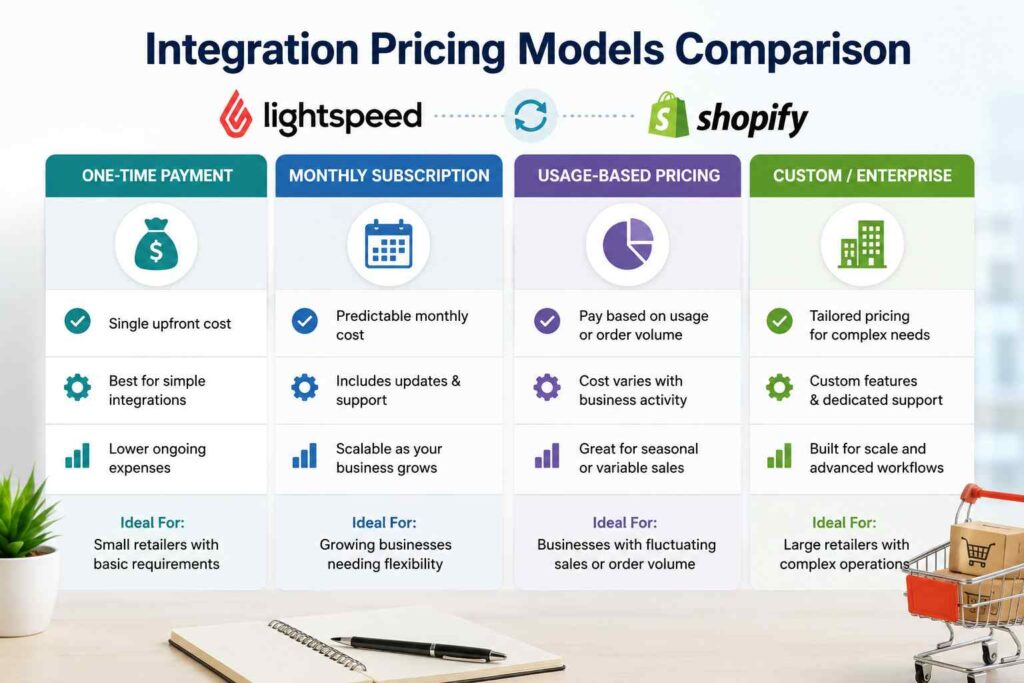
One of the biggest misconceptions among retailers is that every integration solution follows the same pricing structure. In reality, different vendors use different pricing models depending on the features they offer, the level of automation provided, and the amount of implementation support included.
Understanding these pricing approaches can help you compare solutions more effectively.
1. Monthly Subscription (SaaS)
This is the most common pricing model for cloud-based integration platforms.
Instead of purchasing software outright, retailers pay a recurring monthly subscription.
Typically includes:
- Cloud hosting
- Software updates
- Feature enhancements
- Security patches
- Basic technical support
Advantages
- Lower upfront investment
- Continuous product improvements
- Easier budgeting
- Faster deployment
Considerations
- Ongoing monthly cost
- Premium features may require higher plans
- Subscription fees continue as long as the service is used
This model is generally preferred by retailers looking for a scalable, cloud-based integration solution.
2. One-Time License
Some integration providers still offer perpetual licenses.
The retailer purchases the software once and installs it within their own environment.
Advantages
- No recurring subscription fee
- Full ownership of the licensed software
Considerations
- Higher upfront investment
- Future upgrades may cost extra
- Maintenance and hosting may become the retailer’s responsibility
- Long-term support policies vary
This model is becoming less common as cloud-based software gains popularity.
3. Custom Integration Development
Some retailers require workflows that standard integration products cannot support.
Examples include:
- Custom pricing logic
- ERP integration
- Warehouse management integration
- Marketplace synchronization
- Unique business rules
- Complex reporting
Custom development provides maximum flexibility but generally requires more planning, testing, and ongoing maintenance.
Advantages
- Tailored to business requirements
- Greater flexibility
- Can support highly specialized workflows
Considerations
- Higher implementation costs
- Longer deployment timelines
- Ongoing maintenance responsibility
- Future API changes may require additional development
4. Middleware-Based Integration
Middleware acts as an intelligent bridge between Lightspeed Retail POS and Shopify.
Instead of simply transferring data, modern middleware platforms can:
- Validate product information
- Apply business rules
- Handle synchronization failures
- Monitor transactions
- Reduce manual intervention
- Scale as business requirements grow
Cloud-based middleware has become increasingly popular because it balances automation, flexibility, and scalability.
In Short
Retailers should compare the total value delivered by an integration solution – not just the subscription price. Automation capabilities, scalability, reliability, and ongoing support often have a much greater impact on long-term business value than the monthly fee alone.
Typical Cost Components
Retailers often ask,
“What exactly am I paying for?”
The answer depends on the provider, but most integration projects include some combination of the following cost components.
| Cost Component | Description |
|---|---|
| Software Subscription | Monthly or annual platform fee |
| Initial Setup | Configuration and onboarding |
| Product Mapping | Matching products between Lightspeed and Shopify |
| Data Migration | Preparing existing product information |
| Testing | Validation before going live |
| User Training | Staff onboarding |
| Technical Support | Assistance after implementation |
| Custom Development | Optional business-specific enhancements |
| Ongoing Maintenance | Monitoring and software updates |
Some providers bundle these costs together, while others charge separately.
Native Integration vs Third-Party Middleware vs Custom Development
Every retailer’s requirements are different.
Choosing the right integration approach depends on business size, operational complexity, and future growth plans.
| Feature | Native Integration | Third-Party Middleware | Custom Integration |
|---|---|---|---|
| Initial Cost | Low | Moderate | High |
| Monthly Cost | Low–Moderate | Moderate | Varies |
| Automation | Basic | Advanced | Fully Customizable |
| Scalability | Limited | High | Very High |
| Multi-location Support | Limited | Excellent | Depends on Development |
| Maintenance | Vendor | Vendor | Retailer/Developer |
| Implementation Time | Short | Moderate | Longer |
| Flexibility | Limited | High | Maximum |
Retailers evaluating different implementation approaches can also explore our guide to the Best Lightspeed Shopify Integration solutions before making a decision.
Which Pricing Model Is Best?
There isn’t a universal answer.
The right solution depends on your business objectives.
Small Retailers
Often benefit from:
- Standard cloud integrations
- Lower implementation effort
- Faster deployment
Growing Retailers
Typically require:
- Reliable inventory synchronization
- Multi-location support
- Order automation
- Customer synchronization
- Greater operational flexibility
Enterprise Retailers
May require:
- ERP connectivity
- Warehouse integration
- Marketplace synchronization
- Advanced automation
- Custom workflows
Hidden Costs Retailers Often Miss
Many retailers compare software subscription prices but overlook the operational costs that arise when systems do not work together efficiently.
These hidden costs can exceed the software investment over time.
Manual Inventory Updates
Updating inventory manually every day consumes valuable staff time.
Even if each update only takes 30 minutes, the cumulative cost over a year can be substantial.
Overselling
Inventory mismatches may result in products being sold online after they are no longer available in-store.
Consequences include:
- Order cancellations
- Refund processing
- Customer dissatisfaction
- Negative reviews
- Lost repeat business
Duplicate Product Management
Without synchronization, staff often create and maintain product information in multiple systems.
This increases the likelihood of:
- Pricing inconsistencies
- Incorrect descriptions
- Missing images
- Duplicate SKUs
Delayed Order Processing
Manual order entry introduces delays.
This can affect:
- Shipping times
- Inventory availability
- Customer communication
Staff Productivity
Employees spend more time performing repetitive administrative tasks instead of serving customers, merchandising products, or growing the business.
Automation allows retail teams to focus on higher-value activities.
Data Errors
Incorrect product information, inventory quantities, or customer records often require additional time to investigate and correct.
Preventing these issues is generally less expensive than resolving them later.
Total Cost of Ownership (TCO)
When evaluating integration options, retailers should consider the Total Cost of Ownership (TCO) rather than focusing only on subscription fees.
TCO includes:
- Software costs
- Implementation
- Staff time
- Maintenance
- Training
- Support
- Productivity gains
- Reduced operational errors
- Future scalability
The lowest monthly subscription is not always the most economical solution if it requires ongoing manual work or frequent intervention.
Example Evaluation Matrix
| Evaluation Factor | Importance |
|---|---|
| Purchase Price | ⭐⭐⭐ |
| Automation | ⭐⭐⭐⭐⭐ |
| Inventory Accuracy | ⭐⭐⭐⭐⭐ |
| Scalability | ⭐⭐⭐⭐⭐ |
| Ease of Use | ⭐⭐⭐⭐ |
| Customer Support | ⭐⭐⭐⭐ |
| Future Growth | ⭐⭐⭐⭐⭐ |
| Total Cost of Ownership | ⭐⭐⭐⭐⭐ |
Is the Cheapest Integration Really the Cheapest?
When evaluating an Integration between Lightspeed and Shopify solutions, many retailers naturally compare monthly subscription fees first. While pricing is important, choosing the least expensive option without considering long-term business requirements can become significantly more costly over time.
A low-cost integration that requires frequent manual intervention, lacks essential synchronization capabilities, or cannot scale with business growth may increase operational expenses rather than reduce them.
Instead of asking:
“Which integration costs the least?”
Retailers should ask:
“Which integration delivers the greatest long-term business value?”
A well-designed integration helps reduce manual work, improves inventory accuracy, streamlines order processing, and supports future growth. These operational benefits often outweigh differences in subscription pricing.
Total Business Value vs. Software Cost
Rather than comparing software prices alone, consider the broader impact on your retail operations.
| Evaluation Area | Low-Cost Solution | Well-Planned Integration |
|---|---|---|
| Inventory Accuracy | Limited | High |
| Manual Work | High | Minimal |
| Order Processing | Mostly Manual | Automated |
| Product Updates | Time Consuming | Automated |
| Scalability | Limited | High |
| Multi-location Support | Often Limited | Better Supported |
| Long-term ROI | Lower | Higher |
The objective is not simply to reduce software expenses, but to improve operational efficiency across the business.
Common Costs of Poor Integration
Retailers frequently underestimate the financial impact of disconnected systems.
Some of the most common operational costs include:
Lost Sales
Inventory inaccuracies may result in products appearing available online when they have already been sold in-store.
Potential consequences include:
- Cancelled orders
- Refund processing
- Lost customer confidence
- Negative online reviews
- Reduced repeat business
Staff Productivity
Without automation, employees spend valuable time:
- Updating inventory
- Entering online orders manually
- Correcting pricing errors
- Managing duplicate customer records
- Investigating synchronization failures
These repetitive tasks reduce the time available for merchandising, customer service, and business development.
Inventory Inconsistencies
Maintaining product information separately in Lightspeed Retail POS and Shopify increases the likelihood of:
- Duplicate products
- Incorrect pricing
- Missing product images
- Variant mismatches
- Inventory discrepancies
Maintaining a single source of truth significantly reduces these issues.
Limited Business Growth
An integration that works today may become a limitation tomorrow if it cannot support:
- Additional store locations
- Larger product catalogs
- Higher transaction volumes
- New ecommerce channels
- Marketplace integrations
Choosing a scalable solution from the beginning can help avoid costly migrations later.
In Short (Quick Summary)
The lowest subscription price does not always represent the lowest total business cost. Retailers should evaluate integrations based on operational efficiency, automation capabilities, scalability, and long-term return on investment rather than monthly fees alone.
Questions Every Retailer Should Ask Before Choosing an Integration
Selecting an integration solution is an important business decision. Asking the right questions before implementation can help avoid unexpected costs and operational challenges.
1. Which Business Processes Are Automated?
Clarify which activities are synchronized automatically.
Examples include:
- Product information
- Inventory
- Orders
- Customers
- Pricing
- Categories
- Images
- Product variants
Automation requirements differ from one retailer to another.
2. How Frequently Is Inventory Updated?
Inventory synchronization frequency directly affects stock accuracy.
Questions worth asking include:
- Is synchronization near real-time?
- Can synchronization schedules be configured?
- What happens if synchronization is interrupted?
Retailers with fast-moving inventory often require more frequent updates than businesses with slower sales cycles.
3. Does the Solution Support Multiple Store Locations?
Retailers operating more than one physical store should understand:
- How inventory is allocated
- Which location fulfills online orders
- Whether inventory visibility is available by location
- How stock transfers are managed
4. How Are Synchronization Errors Handled?
No integration is immune to occasional failures.
Ask how the system:
- Detects synchronization failures
- Generates alerts
- Logs errors
- Supports recovery after outages
Effective error handling reduces operational disruptions.
5. Is the Solution Scalable?
Retail businesses evolve.
Consider future requirements such as:
- Additional stores
- New ecommerce platforms
- Marketplace integrations
- Warehouse management systems
- ERP connectivity
Selecting a scalable solution today reduces future migration effort.
Retailers should also consider which version of Lightspeed Retail POS they are currently using, as features and integration capabilities can differ between product versions. If you’re unsure which edition best fits your business or how it may affect your integration strategy, our guide on Lightspeed R-Series vs X-Series explains the key differences and the factors retailers should evaluate before making an implementation decision.
6. What Support Is Available?
Implementation is only the beginning.
Understand:
- Support hours
- Response times
- Technical documentation
- Onboarding assistance
- Future software updates
Reliable support contributes significantly to long-term success.
7. What Is Included in the Implementation?
Request clarity on:
- Initial configuration
- Product mapping
- Data migration
- Testing
- Staff training
- Go-live assistance
Knowing what is included helps avoid unexpected costs later.
Decision Checklist
Before selecting a Lightspeed Shopify Integration solution, ask yourself:
✔ Do we require inventory synchronization?
✔ Do we need Shopify orders downloaded into Lightspeed?
✔ Will customer records be synchronized?
✔ Do we operate multiple retail locations?
✔ Are product variants important?
✔ Do we expect business growth over the next few years?
✔ Do we require automation to reduce manual work?
✔ Do we need reliable technical support?
If the answer is “Yes” to most of these questions, investing in a scalable integration solution is likely to provide greater long-term value.
Common Mistakes Retailers Make
Many implementation challenges can be avoided with proper planning.
Some of the most common mistakes include:
Choosing Based Only on Price
Selecting the least expensive option without considering business requirements may increase operational costs later.
Ignoring Existing Data Quality
Duplicate SKUs, inconsistent categories, and incomplete product information often delay implementations.
Preparing data before integration improves results.
Underestimating Future Growth
Retailers frequently select solutions that meet today’s requirements but cannot support tomorrow’s expansion.
Growth planning should be part of every integration decision.
Skipping User Testing
Testing product synchronization, inventory updates, pricing, and order workflows before going live helps identify issues early.
Not Documenting Business Rules
Clearly defining inventory allocation, pricing updates, order processing, and synchronization priorities improves implementation success.
Choosing the Right Lightspeed Shopify Integration Partner
Selecting the right integration solution is only part of the decision. Equally important is choosing a partner who understands retail operations, ecommerce workflows, and the practical challenges of synchronizing two business-critical platforms.
A successful implementation goes beyond simply connecting two systems. It should align with your business processes, reduce manual work, improve inventory accuracy, and support long-term growth.
When evaluating an implementation partner, consider the following:
- Experience working with retail businesses
- Understanding of Lightspeed Retail POS and Shopify workflows
- Ability to recommend the most appropriate integration approach
- Focus on scalability and future expansion
- Transparent implementation process
- Reliable post-implementation support
Rather than selecting a solution based solely on price or marketing claims, retailers should evaluate whether the recommended approach aligns with their operational requirements and future business goals.
Conclusion
Lightspeed Shopify Integration is more than a software purchase – it is an investment in operational efficiency.
Whether you operate a single retail store or multiple locations, the right integration can reduce manual work, improve inventory accuracy, streamline order management, and create a better customer experience across online and in-store channels.
The total cost of an integration should be evaluated in the context of long-term business value rather than monthly subscription fees alone. Factors such as automation, scalability, implementation quality, technical support, and future flexibility all contribute to the overall return on investment.
Every retailer has unique business requirements. The best integration solution is one that fits your current operations while supporting future growth without unnecessary complexity.
If you’re evaluating Lightspeed Shopify Integration options and would like guidance on choosing the most appropriate approach for your business, Retail Matchmaker can help you assess your requirements and recommend an integration strategy designed for your retail environment.
If you’re launching a new online store, our eCommerce Website Development services help retailers build scalable Shopify stores that are designed for future POS integration and omnichannel growth.
Key Takeaway
Choosing a Lightspeed to Shopify Integration should never be based solely on software pricing. Retailers should evaluate the complete business value – including automation, inventory accuracy, operational efficiency, scalability, implementation quality, and ongoing support. A well-planned integration reduces manual work, minimizes costly inventory errors, improves customer satisfaction, and creates a stronger foundation for long-term retail growth.
Frequently Asked Questions
The cost varies depending on your business requirements, the integration solution selected, implementation complexity, number of products, store locations, and the level of automation required. Retailers should evaluate the total business value rather than comparing subscription fees alone.
Pricing is typically influenced by factors such as product catalog size, inventory synchronization requirements, product variants, multi-location support, order automation, customer synchronization, implementation services, and ongoing technical support.
For many retailers, cloud-based integration platforms offer a balance between affordability, scalability, and ease of maintenance. Custom development may be appropriate for businesses with highly specialized workflows but often requires a larger investment and ongoing maintenance.
Yes. Most modern integration solutions synchronize inventory between Lightspeed Retail POS and Shopify to help maintain more accurate stock levels across online and physical stores.
Many integration solutions support automatic order downloads, allowing online orders to be processed within Lightspeed Retail POS without manual data entry.
Many integration solutions support customer synchronization, helping retailers maintain more consistent customer records across both platforms.
Many solutions support multi-location inventory management, enabling retailers to synchronize inventory across multiple stores while managing online sales more efficiently.
Implementation time depends on the complexity of the retail environment, product catalog size, required business workflows, and data quality. Simpler implementations generally require less time than complex multi-location retail environments.
Retailers should consider implementation services, product mapping, data cleanup, staff training, testing, ongoing support, and future scalability in addition to software subscription fees.
The right solution depends on your business processes, growth plans, automation requirements, operational complexity, and support expectations. Evaluating long-term business value rather than software price alone generally leads to better results.
Every retail business has unique operational requirements. Whether you’re evaluating integration options, planning a new Shopify store, or looking to improve synchronization between Lightspeed Retail POS and Shopify, choosing the right approach can save time, reduce operational complexity, and support future growth.
Retail Matchmaker helps retailers evaluate their existing environment, understand available integration options, and implement solutions that align with their business goals.
Contact Retail Matchmaker to discuss your integration requirements and explore the most suitable strategy for your retail business.

