

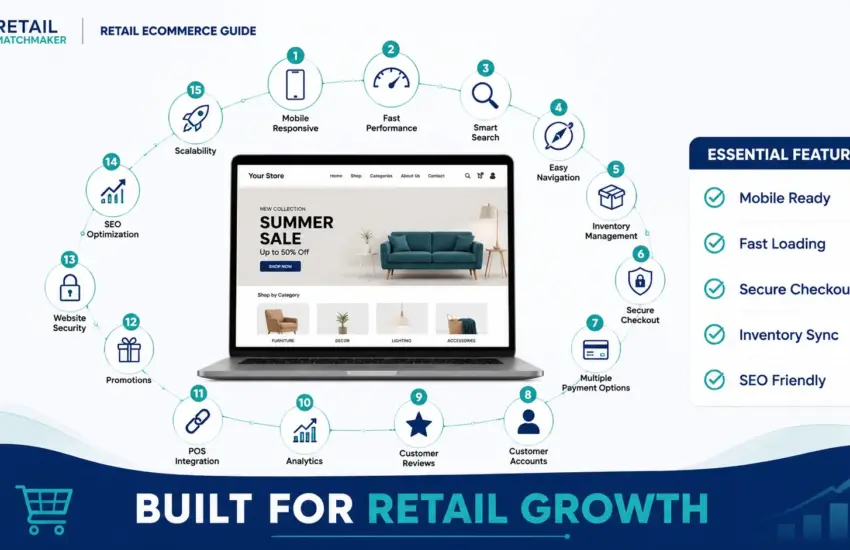
The right retail ecommerce website features can make the difference between an online store that simply exists and one that consistently generates sales. Today’s customers expect fast loading pages, intuitive navigation, secure checkout, accurate inventory, mobile-friendly shopping, and a seamless experience across every sales channel.
Retailers that treat their ecommerce website as a long-term business asset are better positioned to increase online sales, improve customer satisfaction, and support future growth. By including the right features from the beginning, businesses can avoid expensive redesigns and technology limitations later.
If you’re planning a new online store, our Ecommerce Website Development services help retailers build scalable websites that combine excellent user experience with the technical foundation needed for future expansion.
Before deciding which platform to use, you may also find our comparison of Shopify vs WooCommerce for Retailers helpful, especially if you’re evaluating Shopify, WooCommerce, or Magento.
Why Retail Ecommerce Website Features Matter
These retail ecommerce website features help retailers improve customer experience while supporting long-term business growth.
Many retailers compare ecommerce platforms based on appearance or monthly subscription costs. However, the real difference between a successful online store and an average one often comes down to the features built into the website.
The right combination of functionality can help retailers:
- Improve customer experience
- Increase conversion rates
- Reduce cart abandonment
- Simplify inventory management
- Support omnichannel retail
- Improve search engine visibility
- Reduce manual work
- Prepare for future POS integration
Choosing the right features during development is usually much more cost-effective than adding them after launch.
Retailers planning their project budget should also read our guide to Ecommerce Website Development Cost to understand how website features influence overall development investment.
1. Mobile-Responsive Design
More than half of ecommerce traffic now comes from smartphones and tablets. A retail ecommerce website must provide a seamless shopping experience across desktops, laptops, tablets, and mobile devices.
A responsive design automatically adjusts layouts, images, menus, and product pages to fit different screen sizes without compromising usability.
Benefits include:
- Better customer experience
- Higher mobile conversion rates
- Improved SEO performance
- Faster page loading
- Lower bounce rates
Mobile responsiveness is no longer optional – it is a core requirement for every modern retail ecommerce website.
2. Fast Website Performance
Website speed has a direct impact on user experience, conversion rates, and search engine rankings.
Customers expect product pages to load quickly, especially on mobile devices. Even small delays can increase abandonment and reduce sales.
Retailers should prioritize:
- Optimized images
- Efficient code
- Browser caching
- Content delivery networks (CDNs)
- Reliable hosting
- Performance optimization
A fast website creates a smoother shopping experience while supporting better organic visibility.
3. Intuitive Navigation
Customers should be able to find products quickly without unnecessary clicks.
Well-designed navigation includes:
- Clear product categories
- Logical menu structure
- Breadcrumb navigation
- Easy-to-use search
- Product filtering
- Sorting options
Simple navigation reduces frustration and helps customers reach checkout faster.
4. Powerful Product Search
Many shoppers prefer searching rather than browsing.
An effective ecommerce search should support:
- Keyword search
- Product SKU search
- Brand search
- Category suggestions
- Auto-complete
- Typo tolerance
- Filtered search results
For retailers with large product catalogs, search functionality significantly improves the customer experience.
5. Detailed Product Pages
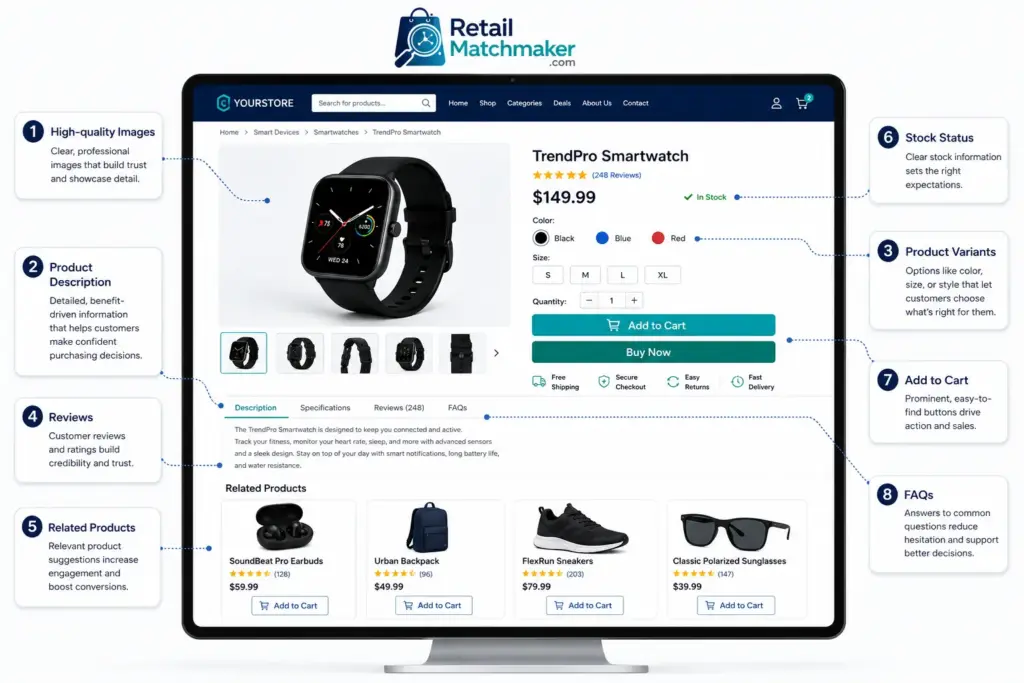
Product pages should provide enough information for customers to make confident purchasing decisions.
Essential elements include:
- High-quality images
- Product descriptions
- Specifications
- Pricing
- Availability
- Product variants
- Customer reviews
- Related products
- Frequently asked questions
Clear and informative product pages improve trust while reducing product-related enquiries.
In Short
The foundation of every successful retail ecommerce website begins with an excellent customer experience. Mobile responsiveness, website speed, intuitive navigation, powerful search, and detailed product pages work together to help customers find products quickly and complete purchases with confidence.
6. Inventory Management and Real-Time Stock Visibility
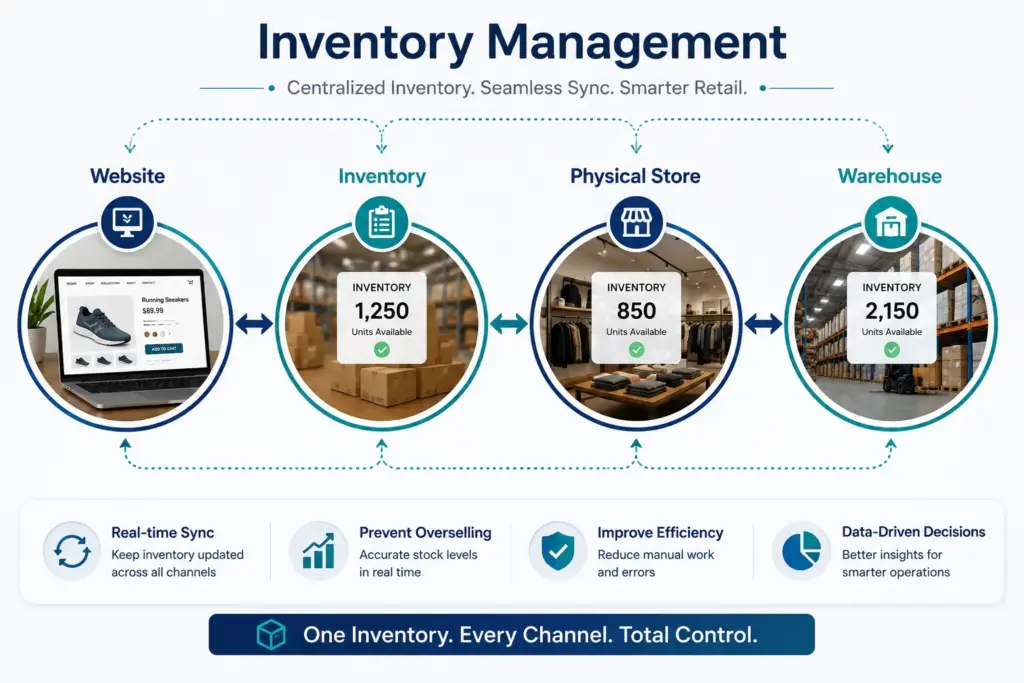
One of the biggest challenges retailers face is maintaining accurate inventory across online and physical stores. Nothing frustrates customers more than purchasing a product online only to discover that it is out of stock.
A retail ecommerce website should support:
- Real-time inventory updates
- Product availability status
- Stock level notifications
- Backorder management
- Multi-location inventory visibility
- Automatic inventory adjustments
Accurate inventory not only improves customer satisfaction but also reduces cancelled orders and manual stock corrections.
Retailers planning future inventory synchronization should also understand Why Retailers Need a Specialized Ecommerce Website, as inventory management is one of the biggest differences between retail ecommerce and general ecommerce websites.
7. Secure Checkout Experience
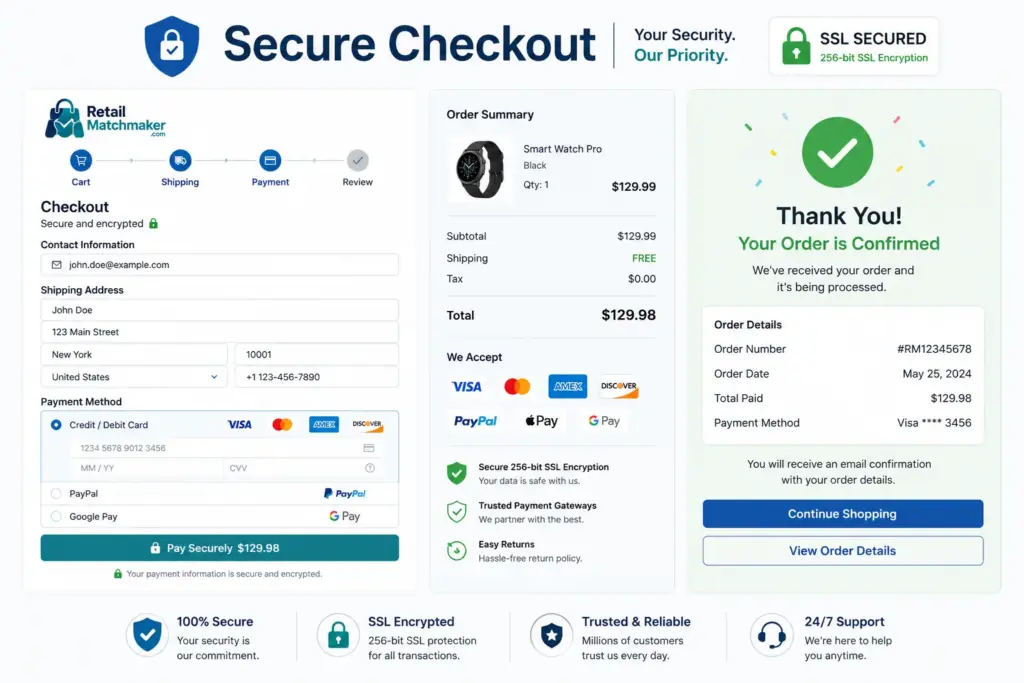
Customers expect a fast, secure, and friction-free checkout process.
A complicated checkout is one of the leading causes of cart abandonment.
An effective checkout should include:
- SSL encryption
- Guest checkout
- Address auto-completion
- Multiple shipping options
- Order summary
- Coupon code support
- Mobile-friendly checkout
- Clear progress indicators
The fewer obstacles customers encounter during checkout, the higher the likelihood of completing the purchase.
8. Multiple Payment Options
Every customer has a preferred payment method.
Supporting multiple payment gateways improves convenience and can increase completed transactions.
Common payment methods include:
- Credit and debit cards
- PayPal
- Apple Pay
- Google Pay
- Shop Pay
- Buy Now, Pay Later (BNPL) services
- Gift cards
- Store credit
Retailers should choose payment options based on their target market while ensuring all transactions are processed securely.
9. Customer Accounts and Order History
Returning customers expect quick access to their previous purchases and account information.
Customer accounts should provide:
- Order history
- Saved addresses
- Wishlist functionality
- Saved payment methods (where supported)
- Easy reordering
- Return request tracking
- Account preferences
These features improve convenience while encouraging repeat purchases and long-term customer loyalty.
10. SEO-Friendly Website Architecture
Google provides detailed guidance on creating search-friendly websites in its Search Essentials documentation.
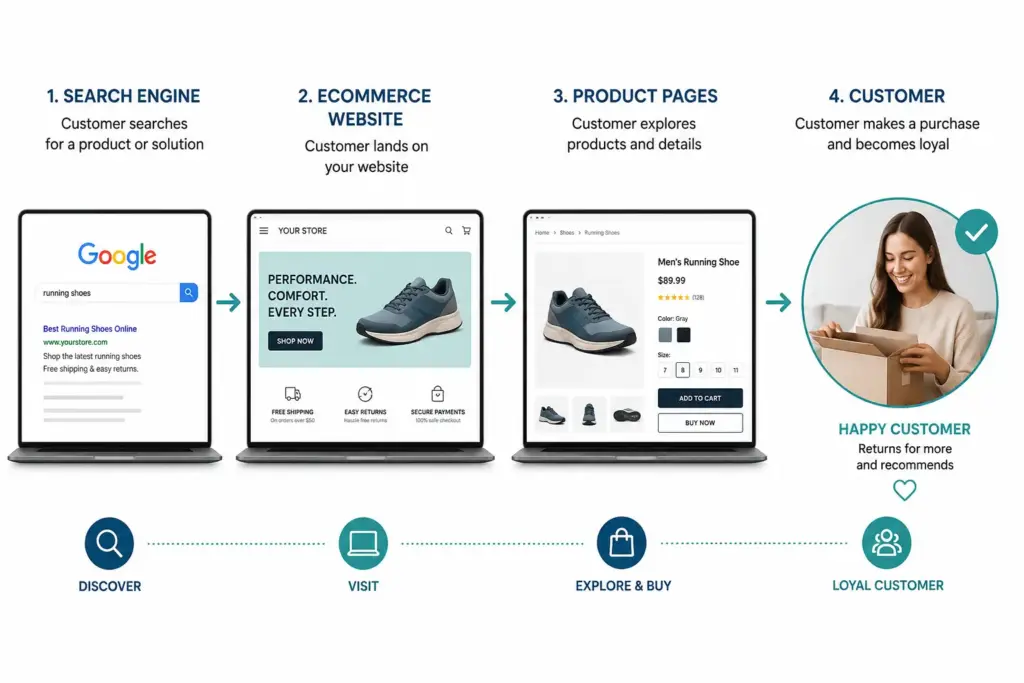
Even the most attractive ecommerce website cannot generate organic traffic without proper search engine optimization.
SEO should be considered during website development rather than added later.
Important SEO features include:
- Clean URL structure
- Optimized heading hierarchy
- XML sitemap
- Internal linking
- Schema markup
- Optimized image ALT text
- Canonical URLs
- Fast page loading
- Mobile responsiveness
Together, these retail ecommerce website features create a strong foundation for search visibility and operational efficiency.
A well-structured ecommerce website helps search engines understand your content while making it easier for customers to find your products.
If you’re planning a new online store, our Ecommerce Website Development service includes SEO best practices as part of the website architecture rather than treating SEO as a separate project after launch.
Comparison Table
| Feature | Why It Matters |
|---|---|
| Inventory Management | Prevents overselling and improves stock accuracy |
| Secure Checkout | Reduces cart abandonment and builds customer trust |
| Multiple Payment Options | Increases completed purchases |
| Customer Accounts | Encourages repeat business and loyalty |
| SEO-Friendly Architecture | Improves search visibility and long-term organic traffic |
In Short
The next generation of retail ecommerce websites goes beyond attractive design. Features such as inventory management, secure checkout, flexible payment options, customer accounts, and SEO-friendly architecture directly influence customer satisfaction, operational efficiency, and online sales performance.
11. Future POS Integration
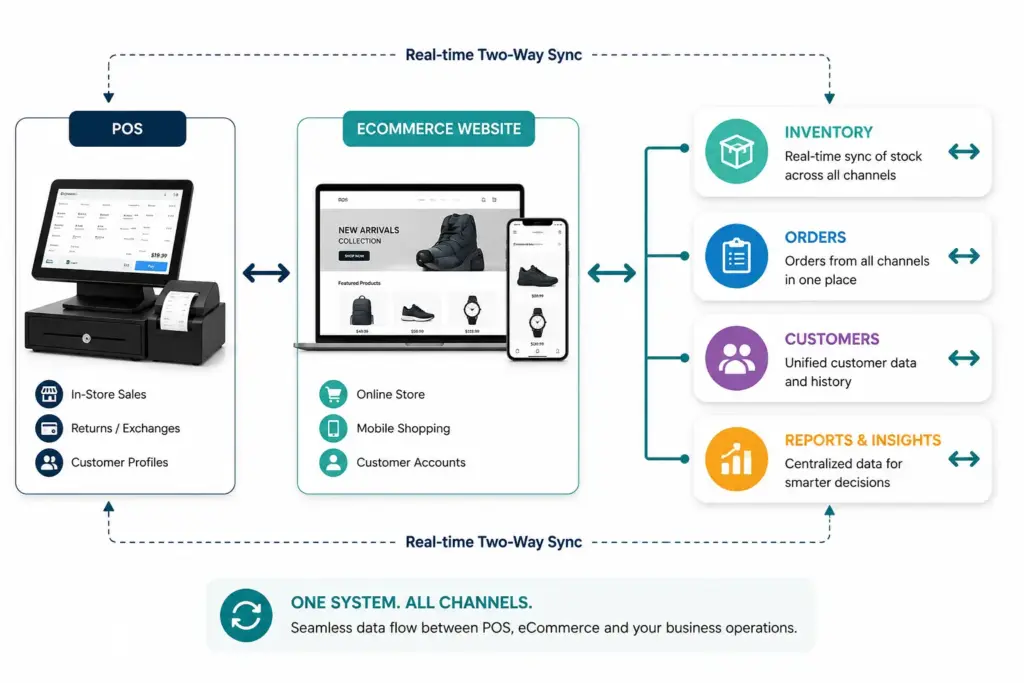
Many retailers initially launch an ecommerce website without connecting it to a retail POS system. As the business grows, manually updating inventory, pricing, and orders across multiple systems becomes increasingly time-consuming and prone to errors.
A future-ready retail ecommerce website should be designed with POS integration in mind, even if the integration is not required immediately.
Benefits include:
- Centralized product management
- Inventory synchronization
- Automatic order updates
- Consistent pricing
- Reduced manual data entry
- Improved operational efficiency
Retailers planning future integrations can explore our Lightspeed Shopify Integration solutions to understand how connected retail systems improve day-to-day operations.
12. Customer Reviews and Social Proof
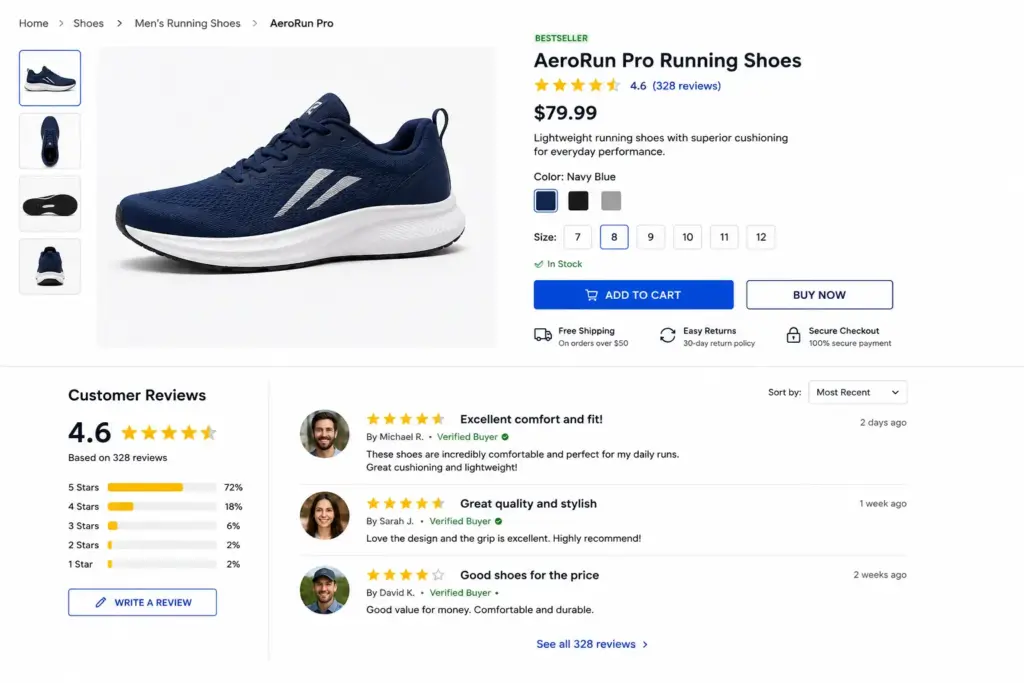
Online shoppers rely heavily on reviews before making purchasing decisions.
Displaying genuine customer feedback helps build trust and encourages new visitors to complete their purchases.
A retail ecommerce website should include:
- Product ratings
- Written reviews
- Verified purchase badges
- Customer photos (where appropriate)
- Questions and answers
- Testimonials
Authentic social proof often influences buying decisions more effectively than promotional content.
13. Promotional and Marketing Tools
An ecommerce website should help retailers grow sales – not simply process transactions.
Useful promotional features include:
- Discount codes
- Percentage and fixed-price promotions
- Free shipping offers
- Gift cards
- Upselling
- Cross-selling
- Product bundles
- Seasonal campaigns
- Abandoned cart recovery
- Email marketing integration
These tools help increase average order value while encouraging repeat purchases.
14. Reporting and Analytics
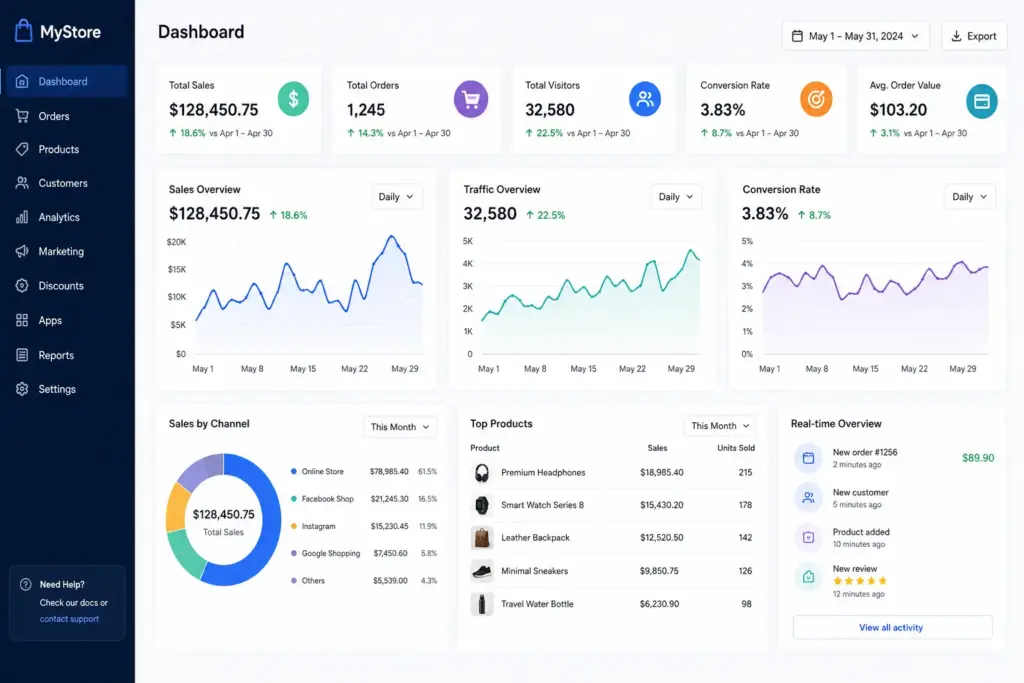
Business decisions should be based on data rather than assumptions.
Retailers should have access to reports covering:
- Sales performance
- Product performance
- Customer behaviour
- Conversion rates
- Cart abandonment
- Revenue trends
- Traffic sources
- Inventory movement
Analytics help retailers identify opportunities for improvement while measuring the effectiveness of marketing campaigns and operational changes.
15. Scalability for Future Growth
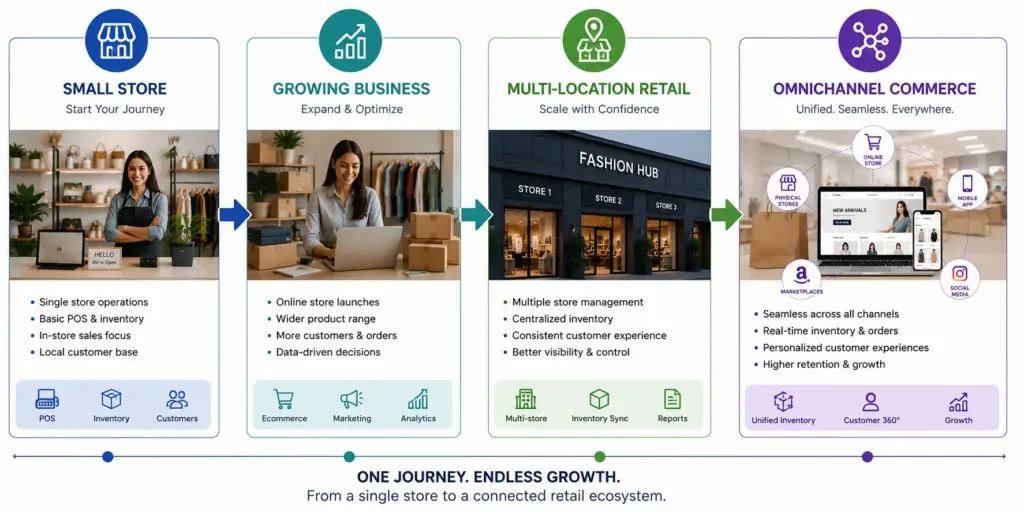
The best ecommerce websites are designed not only for today’s requirements but also for tomorrow’s opportunities.
As retail businesses grow, they often introduce:
- New product categories
- Additional store locations
- Marketplace selling
- International shipping
- Loyalty programmes
- B2B ecommerce
- Advanced integrations
- AI-powered customer experiences
A scalable website allows retailers to expand without rebuilding their entire ecommerce platform every few years.
Retailers comparing long-term technology investments should also review our guide to Ecommerce Website Development Cost to understand why planning for future growth often reduces overall ownership costs.
Feature Summary
| Essential Feature | Business Benefit |
|---|---|
| Mobile-Responsive Design | Better customer experience across all devices |
| Fast Website Performance | Higher conversions and improved SEO |
| Intuitive Navigation | Easier product discovery |
| Powerful Product Search | Faster purchasing decisions |
| Detailed Product Pages | Increased customer confidence |
| Inventory Management | Accurate stock visibility |
| Secure Checkout | Reduced cart abandonment |
| Multiple Payment Options | Higher completed transactions |
| Customer Accounts | Better customer retention |
| SEO-Friendly Architecture | Increased organic traffic |
| Future POS Integration | Connected retail operations |
| Customer Reviews | Stronger trust and credibility |
| Promotional Tools | Higher average order value |
| Reporting & Analytics | Better business decisions |
| Scalability | Long-term business growth |
These retail ecommerce website features work together to improve customer experience, streamline operations, and create a scalable foundation for long-term retail growth.
Retail Matchmaker’s Perspective
A retail ecommerce website should do much more than showcase products. It should become an integral part of your retail operation, supporting inventory management, customer experience, marketing, and future business expansion.
At Retail Matchmaker, we design ecommerce websites specifically for retailers. Our Ecommerce Website Development services focus on creating scalable, SEO-friendly online stores that are prepared for future POS integration, omnichannel retailing, and long-term business growth.
Every retailer has unique operational requirements, which is why we begin each project by understanding your products, workflows, and growth plans before recommending the right technology solution.
Key Takeaway
A successful retail ecommerce website is built on the right combination of technology, user experience, and business strategy. By including these 15 essential features from the start, retailers can improve customer satisfaction, streamline operations, strengthen search visibility, and create a platform that supports sustainable growth.
Frequently Asked Questions
Mobile responsiveness, fast performance, inventory management, secure checkout, SEO-friendly architecture, customer accounts, and future POS integration are among the most important features.
Accurate inventory prevents overselling, improves customer satisfaction, and reduces manual stock adjustments across online and physical stores.
A responsive website provides a better shopping experience on smartphones and tablets, helping reduce bounce rates and improve conversion rates.
Yes. Genuine customer reviews build trust, improve purchasing confidence, and often increase conversion rates.
Planning for future POS integration helps reduce redevelopment costs and supports inventory synchronization, centralized product management, and omnichannel retail.
Yes. SEO-friendly architecture should be part of the development process to ensure search engines can efficiently crawl and index the website.
Shopify, WooCommerce, and Magento all support these capabilities when implemented correctly. The right choice depends on your business requirements.
Yes, but adding important functionality during development is usually more cost-effective than making major changes later.
Analytics provide insights into customer behavior, sales trends, marketing performance, and inventory movement, helping retailers make informed decisions.
Retail Matchmaker helps retailers build feature-rich ecommerce websites that support customer experience, inventory management, SEO, and future retail technology integrations.
Conclusion
A retail ecommerce website is no longer just an online sales channel – it is a critical part of your business infrastructure.
Including the right features from the beginning improves customer satisfaction, simplifies operations, supports future expansion, and helps create a competitive advantage in today’s retail environment.
Rather than focusing only on appearance, retailers should invest in functionality that delivers long-term business value.
By combining strong user experience with scalable technology, your ecommerce website can continue supporting your business as customer expectations and operational requirements evolve.
Investing in the right retail ecommerce website features today helps retailers avoid costly redevelopment while supporting future omnichannel expansion.
Ready to Build a Feature-Rich Retail Ecommerce Website?
Whether you’re launching a new online store or upgrading an existing one, Retail Matchmaker can help you build an ecommerce website designed for long-term success.
Our team specializes in creating retail-focused ecommerce solutions that combine outstanding customer experience with inventory management, SEO best practices, and future POS integration.
Contact Retail Matchmaker today for a free consultation and discover how the right ecommerce website can help your retail business grow.

